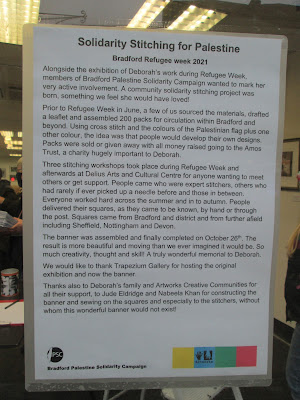
The banner was launched today at Trapezium Arts, 58 Kirkgate, Bradford BD1 1QT; it was a pleasure to go over there for this. She would have so liked the whole project. It will be on display in the window there during its Christmas / New Year break until towards the end of January.
Monday, 20 December 2021
First anniversary of Deborah's death
The banner was launched today at Trapezium Arts, 58 Kirkgate, Bradford BD1 1QT; it was a pleasure to go over there for this. She would have so liked the whole project. It will be on display in the window there during its Christmas / New Year break until towards the end of January.
Friday, 17 December 2021
I am the Alpha, Omicron and Omega
Sunday, 31 October 2021
Three anxiety dreams
I had a dream recently in which I couldn’t get things ready for an imminent funeral: the prepared notes were missing, the robes hard to find, the journey full of wrong turnings, the sense never breaking that the mourners would be waiting but I’d never quite get there.
A very straight forward and unremarkable anxiety dream then.
But it surprised me for a couple of reasons. Despite a hugely difficult couple of years, one thing I haven’t been having has been anxiety dreams. And when, longer ago, I did have them, they were consistently about not being ready for exams: somewhere less unlike my school’s campus than unlike my University’s setting, with the noticeboard, the syllabus, the tutor and the library all somehow equally inaccessible however much I searched.
And then I was sitting at the back of a Deanery Synod meeting having arrived in just good enough time, but too far back to catch everything being said at the front. Despite trying to pace myself better this autumn, I’d worked all day and then come out for an evening meeting as well because the one substantive item was Looking after God’s creation: what changes can parishes and individuals make to have a positive impact which seemed important enough.
I’ve perhaps been a little mis-sold, the speaker began to say, and I was back robe-less and syllabus-denied, in a bad dream, unable to get anywhere.
Relevant words were dangled before us, and we were given time to react to them with neighbours. We began with Generosity, having been primed strangely with a story about what may have been a rich elderly expatriate in Monaco giving one of her high specification cars for the use of the local Anglican Chaplain. Acceptable feedback turned out to be about giving money to the church, with family-creating, kidney-donating, time-sacrificing, debt-releasing, salvation-procuring generosity somehow inaccessible.
Stewardship was up next, and the nature of the topic-misunderstanding, which those who arrived earlier or who sat closer to those in the know at the front may well have already readily understood, became apparent. It wasn’t the commission at almost the start of the Bible for humans to care, look after or steward creation which we were to explore, but all things were to refer back to giving money to the church.
Time was running out as first-fruits was tabled as the third point of reference, and the side reference from the front indicated that this too was to be taken as being about giving to God (proxy at this point for temple and church rather than creation and neighbour) before all else, and all the fruitful possibilities of what comes fruitfully into my hands being primarily for the common good rather my individual consumption remained frustratingly, unpickably out of my reach.
Saturday, 9 October 2021
Little energy
Sunday, 12 September 2021
Buckling down?
Friday, 20 August 2021
Artistic apprehension
I’ve been helped by a gradual realisation that attending to chunks of John’s Gospel may work best if viewed as listening to music rather than following a line of reasoning.
My knowledge of music theory is minimal, but I’m vaguely aware of the way in which a theme might be stated by one instrument, repeated, picked up by another instrument or by the whole orchestra, developed, and revisted. I can often clearly hear this going on and, whether I do or not, can often feel the emotional pull of the theme’s reappearance. I am more often simply unaware that this pattern is what has given a satisfying shape to the listening experience.
So, as we work our way to the fifth of the five Sundays when the whole of John 6 is being read, I put away previous years’ irritation at having to preach around “I am the bread of life” so many Sundays running, and my desperation that the choice of appropriate hymns was exhausted in about the second of the five weeks.
From the opening hint that this is the Passover movement of the piece, and then the rehearsing of the feeding of thousand men, there is unleavened bread, lamb-blood-daubed doorposts, barley loaves and fish. With a change of tune there is Jesus walking on water and the “I am” announcement. Then the gift of manna in the wilderness is layered in, until the “I am the bread of life” theme is finally stated at verse 35, expanded upon, partially reflected back at verse 41, repeated at verse 48, and developed at verse 51. Suddenly in that verse we have soared into eating flesh and blood, sounded out with variations in each of successive verses 53, 54, 55 56 and 57.
We haven’t been argued into a fresh understanding but swept up into it; our tune; the phrases which recur in our heads long after the music has stopped.
And then, for other reasons, I happened to take down William Temple’s Readings in St John’ Gospel * and found the third of three ‘general considerations’ he gives in his Introduction does not use the analogy of music but gets very close to the same awareness saying
One marked characteristic
of the mind of the Evangelist... is... he does not argue from premises to
conclusions as a method of apprehending truth.
Rather he puts together the various constituent parts of truth and contemplates
them in their relation to one another.
Thus he seems to say ‘look at A; now look at B; now at AB; now at C; now
at BC; now at AC; now at D and E; now at ABE; now at CE’, and so on in any
variety of combinations that facilitates new insight. It is the method of artistic, as distinct
from scientific, apprehension, and is appropriate to truth which is in no way
dependent on, or derived from, other truth, but makes its own direct appeal to
reason, heart and conscience.
* Having coincidentally most recently posted about my paternal grandparents being cousins, children of sisters Jessie and Annie Mallam, themselves granddaughters of the Oxford Mayor Thomas Mallam, I mention in passing that the book is dedicated to the memory of Temple’s school friend Professor J L Stocks who was a cousin of both of my grandparents as a son of Jessie and Annie’s sister Emily.
Monday, 9 August 2021
Five generations back
Passing through Oxford at the end of last month, I sought out this 1840 boundary stone of which I hadn’t been aware until quite recently.
It is on the edge of Port Meadow at the point at which the city of Oxford’s common land abuts that of Wolvercote parish. An extensive contemporary newspaper article gives an account of that year’s mayor (and a whole company) inspecting (rather than ‘beating’) the bounds of the city. They discovered that the marker at this point needed renewing with a fresh stone – it is hard now to recognise the city’s coat of arms at the top and the names of the mayor (‘Mallam’) and sheriff beneath with the date.
My father’s parents were cousins, their mothers being sisters (Jessie and Anne Mallam, granddaughters of this mayor). And his grave is here.