Showing posts with label Church. Show all posts
Monday, 26 November 2012
Unrepresentative Synod
I’d much prefer to be typing about our annual visit to the seal breeding colony on the Lincolnshire coast on Friday , but there it is. The bottom picture is a turnstone feeding on seal placenta.
The General Synod vote was a train crash waiting to happen, and it doesn’t give me any pleasure to say this was set out in my post of 14th July 2008.
Among the informed lay people who have been involved in discussing this issue there are some who take the position that the Church of England is not in a position to develop its tradition in this way at least without the consensus of the major Catholic and Orthodox churches; our continuity with the pre-Reformation church has never been fundamentally fractured. But they are in a small minority; the rest see careful weighing of our own place in a developing tradition as what happened at the Reformation and what continues to happen today.
Among them there are some who take the position that the Church of England is not in a position to diverge from a biblical interpretation which forbids women from taking leadership authority in the church; we are not free to make moves which a literal interpretation of any New Testament text would forbid. But they are also a small minority; the rest see careful weighing of the bible in our present context as what has happened at every stage of Christian history.
We know the size of these minority positions for two reasons. One is that only 7% of the parishes in the Church of England have taken advantage of the provision made at the time of the first ordinations of women as priests to ring fence themselves against their ministry. The other is that over the last year between them over three quarters of the members of the Houses of Laity in each Diocesan Synod have voted in favour of legislation to allow the consecration of women as Bishops.
So for 36% of the House of Laity of the General Synod to vote against this legislation was both entirely predictable and fundamentally misrepresentative of the mind of the church.
A hundred years ago England still refused women the vote and resisted their place in professions such as medicine. For the hundred years since, in the same way that those who found the Holy Spirit given to Gentiles as much as to Jews and brought their recommendation that such people could not be excluded from the church to the central authorities of the early church in Jerusalem, people have been bringing again and again to state and church irrefutable testimony that women’s voting, working, ministering and leading are as grace-filled as those of men. We can be respectful of those who take specific minority views on how we handle tradition and scripture, but there is no way of avoiding this truth self evident both to society and to the growing consensus in our church.
There are two ways forward from here. One is that, after behind the scenes negotiations, the six senior members of the General Synod will exercise their right to have the legislation re-presented, with safeguards for conscientious objectors more explicit, and passed next year. The other more tortuous and tedious path is that the next round of elections to the General Synod will be conducted with a sharp awareness that the militant tendencies of the church should never be over represented again.
This parish has produced as ordinands or has had serve in it as licensed clergy twelve priests who are women (Anne now Chaplain of our local Hospital, the late Bridget, the late Christine, George still working with us, Jan, Jenny, Judy still living in the parish and now a Canon of our Cathedral, Julie, Linda, Pauline, Sue and Terrie) and any implication that they are not real priests or that their fellow women priests are somehow incapable of being bishops would be laughable if it were not so sad.
Monday, 22 October 2012
Where we are
The church doesn’t really know how to operate in a post-Christian society. It isn’t our fault. It is simply that we have no experience of doing it on which to build. This isn’t an original thought, but it is brought back to mind by my recent post about our mission situation and by a recent shift in the Baptism policy of the Cleethorpes parishes.
The church knows how to operate in a pagan society. It has a lot of experience of this - this is where it begun and where it is in many parts of the world today. In these circumstances Baptism is a carefully guarded gateway (albeit most Biblical examples in fact evidence very little preparation).
It knows how to operate in a Christian society. It has a lot of experience about this - this is where we have been in our European culture for many centuries. In these circumstances Baptism is an open way (albeit followed up by sometimes quite substantial later formation).
Some of us persist in seeing a Christian society around us (with some justification when we are welcomed in schools, and when we are asked to pray by strangers) so we continue to use the open approach. Because there are substantial Christian elements in a post-Christian society, this sometimes works well. When it does, the process of human ‘confirmation bias’ means we take this to be strong evidence that we are doing the right thing (and ignore the way we can be seen to peddle ‘cheap grace’).
Some see a pagan society around us (with equal justification when large Baptism congregations are uninterested and unresponsive, and when secular values dominate) and so revert to a more fenced approach. Because there are substantial pagan elements in a post-Christian society, this also sometimes works well. When it does the same human tendency to self justification means we also take it to be strong evidence that we are doing the right thing (and ignore the way we can be seen to provoke long term hostility).
But my instinct is that we have simply not yet found out how to operate in the complex and changing post-1960s society. An often liberal instinct towards inclusiveness and an often evangelical instinct towards rigourous commitment both arise from Gospel values and both feel consistent, justified and neat. But until we are better nuanced in our understanding of the complex situation in which the church now exists any subtlety about policies of engagement (let alone Baptism) doesn’t seem very likely.
The picture is another of Kirmington church, this time taken next to the lights ahead of the runway at Humberside Airport.
The church knows how to operate in a pagan society. It has a lot of experience of this - this is where it begun and where it is in many parts of the world today. In these circumstances Baptism is a carefully guarded gateway (albeit most Biblical examples in fact evidence very little preparation).
It knows how to operate in a Christian society. It has a lot of experience about this - this is where we have been in our European culture for many centuries. In these circumstances Baptism is an open way (albeit followed up by sometimes quite substantial later formation).
Some of us persist in seeing a Christian society around us (with some justification when we are welcomed in schools, and when we are asked to pray by strangers) so we continue to use the open approach. Because there are substantial Christian elements in a post-Christian society, this sometimes works well. When it does, the process of human ‘confirmation bias’ means we take this to be strong evidence that we are doing the right thing (and ignore the way we can be seen to peddle ‘cheap grace’).
Some see a pagan society around us (with equal justification when large Baptism congregations are uninterested and unresponsive, and when secular values dominate) and so revert to a more fenced approach. Because there are substantial pagan elements in a post-Christian society, this also sometimes works well. When it does the same human tendency to self justification means we also take it to be strong evidence that we are doing the right thing (and ignore the way we can be seen to provoke long term hostility).
But my instinct is that we have simply not yet found out how to operate in the complex and changing post-1960s society. An often liberal instinct towards inclusiveness and an often evangelical instinct towards rigourous commitment both arise from Gospel values and both feel consistent, justified and neat. But until we are better nuanced in our understanding of the complex situation in which the church now exists any subtlety about policies of engagement (let alone Baptism) doesn’t seem very likely.
The picture is another of Kirmington church, this time taken next to the lights ahead of the runway at Humberside Airport.
Monday, 1 October 2012
The absence of elephants
The demography of our congregations is such that the presence of those who were formed as present and future members of the Church of England in the 1920s, 30s, 40s and 50s has masked the startlingly smaller number so formed in the 1960s, 70s, 80s and 90s, but as they begin to die the huge gap is exposed.
This is something I’ve posted twice before. I’ve now been trying to do some work to get my brain clear for the next meeting of the deanery Mission Area Planning Group, and what I’ve found myself typing is that, despite our doing what we thought were all the right things in the parish over twenty years, the elephants born in 1960s onwards are simply not in the room.
An article in the Church Times last week picked up the radically different level of charitable giving by those born during and between the two World Wars (exactly those who were teenagers in the 1920s, 30s, 40s and 50s) compared especially with those born since 1966 (the oldest of whom became teenagers when the Thatcher Government began - exactly those we hardly ever recruit); it compared more than simply the social cohesion of the first with the individualism of the second.
Earlier in the month it had carried another article which described huge church growth in England in the last few years but admitted that areas with static or shrinking populations, little ethnic diversity, and low economic dynamism have tended to see less church growth... (which) suggests we need to be realistic about those contexts which are toughest; it is harder to grow a church in Middlesborough than Middlesex.
Meanwhile, also this month, the Grimsby Telegraph reports a local rural church facing £200 000 of repairs with fifteen regular attenders who are no longer able to furnish things from Chuchwardens and PCC to engagement with the local school and so it may shut. If it does so it will not be the first, nor (given the number of churches where literally the youngest regular attender is well above retirement age) will it be the last.
These three articles caught my attention and flavour my awareness at the moment, but they don’t say anything we did not really already know: we are trying to attract later generations into a pattern of church commitment and life of an earlier generation; we are trying to do so in one of the least promising social setting in the country; and these truths are so unpalatable that we do not pay any real attention to them in our discussion or planning.
Of course there are exceptions, and a number of individuals brought into our present pattern of discipleship and organisation each year, but, nevertheless, the general points remain stubbornly true. So I wonder whether deanery planning ought now to seek someone who will specialise in helping key churches in the deanery provide something new which addresses those aged 25-55 in our community.
And whether parish planning should carve out significant time to follow up the way a previous Curate talked briefly before she left with some of those in this age group who attend our regular worship or alternative provision and with a handful of those who come to us to request Baptism and Marriage to pay much more attention to their habits and thinking before we plan anything else which is new.
Meanwhile, we enjoyed lots of the details in this Last Supper scene, which comes again from the Burrell Collection.
Monday, 17 September 2012
Polishing leaves
Our Area Bishop has announced his retirement at the age of 59. Although we might well have expected him to carry on for another five to ten years, one can understand why a Bishop, after twelve years in post, wants to take what he calls the ‘risky step’ of exploring whether the years before final retirement could be used doing new things.
We shall be poorer for the absence of his strengths - everything from his personal way of conducted Confirmation services to his clear sighted view of the changing landscape within which the church operates.
It is a challenging image from a Sabbatical he undertook a while ago which I may remember best - set out here from the beginning of an article in his own old Blog:
The most valuable aid to my thinking came from a fig tree... When I arrived, the tree looked magnificent, with leaves of a dimension that could cope with any Adam. The fruit was forming, although still bright green and firm.
What I had not realised was how sterile a fig tree could be in terms of other life... [until], as the summer moved on and the fruit ripened, the tree developed a community of its own - a community drawn to the fruit. There were insects and birds eating the fruit, birds eating the insects, and birds eating other birds.
Inevitably, my mind was drawn to the passages in Mark and Matthew where Jesus goes to a fig tree looking for fruit, finds none, and curses the tree so that it withers and dies… Israel, with so much potential for responding to God’s desire to engage with his creation, had let God down.
The cursing of the fig tree and other episodes such as the clearing of the temple and Jesus’ turning water into wine, speak of God moving on in the person of Jesus – the new wine of God’s relationship with the created. God’s agenda was not to be held back by the Jewish religiosity of the time which produced vast amount of religious leaves – but when those hungry for God reached into those leaves, there was nothing there. It was all leaf.
Observing the fig tree, I realised that as the fruit was eaten or fell to the ground, the vibrant community which had gathered and established itself, disappeared with the fruit. The tree became very dull – still plenty of leaves but very dull…
The danger for a Church is that it can be all leaf. It may ‘look the part’ on the human landscape but it may in fact be fruitless – and God moves on. It is fruit that reveals God’s relationship with his creation, and the religiosity, the system and structure of Judaism, had let God down – and Jesus cursed that tree…
I could not help but see the danger for the Church in our age. It can be good at producing leaves of religiosity – reports from Synod; new liturgy; umpteen commissions and renewal schemes – but where is the fruit?
With this in mind, as I studied church growth, I found I was frequently reading about institutional survival. This was true even of material from the evangelically minded independent churches. When we talk about growth, we’re usually talking about more members for the institution, and fruitfulness comes a long way down the list of what the Church might offer the world.
In a tree there is an essential balance between leaves and fruit. Leaves are essential for the producing of fruit. They are essential for the health of the whole tree, but they are not the purpose of the tree. There is a delicate balance between the need for a tree to have the structure and mechanisms needed to give it life, and the fruit, which is the purpose and future of the tree.
We talk about how to ‘grow’ the church but we are caught up with conversations about institutions and ‘leaves’. Yet without fruit how dull the tree is – no community, no vibrancy of life, nothing for those who hunger. The question hangs there: ‘what is the purpose?’
When I recognised the dullness of the fruitless tree, I recalled the rubber plants and cheese plants of the 1960s and 1970s. In truth, they were very dull plants, but we tenderly cared for these monsters growing in our living rooms. We bought bottles of leaf shine, so that with leaves carefully polished they looked splendid, but actually they continued to be very dull plants. For me, it sometimes feels that much of what we do in the Church is actually polishing leaves!
The picture is of the Deserted Mediaeval Village site at Brackenborough Hall.
Monday, 3 September 2012
Split-brain Anglicanism
Is there a link between the two sides of the human brain and the division which runs down the centre of modern Christianity?
I need to read Ian McGilchrist’s The Master and the Emissary. It’s author says it ‘argues that the division of the brain into two hemispheres is essential to human existence, making possible incompatible versions of the world, with quite different priorities and values’. I’ve just been filing a recent discussion of the book by Mark Vernon in The Tablet (http://www.markvernon.com/friendshiponline/dotclear/index.php?post/2012/06/21/Neurospirituality) which make it clear that this isn’t an idea that the left brain is rational and the right brain emotional.
Rather what Gilchrist appears to think is going on is a left brain whose ‘personality’ seeks precision and certainty, putting in an order the knowable it has encountered; without this we would be unable to navigate our way around anything. Meanwhile the right brain has a ‘personality’ which is simply more open, making new connections, exhibiting ‘negative capability’; without this we would be imprisoned by the inevitably partial maps with which we operate.
The suggestion is that we need both kinds of attention to survive: the narrow conceptualising focus of the left brain and the open engagement of the right brain; the ability to stand back and to continue to be a participant at the same time; a definite distant view but not from a final undetached position.
What struck me about this is the way it parallels the ‘metaphors about the extreme danger those of us in the Church of England have been in from the beginning when we engage in the theological enterprise’, to quote a letter of mine published in Theology in 2000. Examples I used included ‘a tightrope with infallibility on one side and apostasy on the other’ (Paul Avis 1986) and ‘between the Scylla of free-floating spirituality and the Charybdis of over-reactive fundamentalism’ (Advisory Board of Ministry 1996).
It is something I traced in Doctrine Commission reports: ‘if we apply words to God in their ordinary literal or univocal sense, then we all too easily make God in our own image and fall into idolatory; if we use them in an entirely different or equivocal sense, then we have no reason for using one word rather than another, and we are lost in agnosticism’ (1976) and there being ‘no satisfactory way of avoiding [problems] by the sectarian or by the latitudinarian route’ (1981).
So I wrote about ‘the dangers for conservatives of falling into idolatry, infallibility, over-reactive fundamentalism and sectarianism’ and ‘the dangers faced by liberals of falling into agnosticism, apostasy, free-floating spirituality and latitudinarianism’ while ‘I continue to long for pieces of internal Anglican polemic which actually take the two dangers equally seriously’.
Now, might McGilchrist’s analysis help? Do these tensions in Anglicanism simply reflect tensions in all integrated thinking and living? Is it only isolated left brain working which is stuck with the formulations on which we depend to know? Is it only isolated right brain working which gets lost in the endless possibilities it isn’t safe to ignore? Is it only (normal!) whole brain living which is essential if we are to navigate round all this?
Of course, those who have engaged in theories of language have already been on to much of this, so I ought to go back to those next. What I have begun to read is Malcolm Guite’s Faith, Hope and Poetry. I keep getting distracted by following up the individual poems to which he pays attention. But (part from his treatment of language, symbol, faith and imagination) I’ve already spotted at the very beginning that what he identifies as the Enlightenment dilemma matches step for step my Theology quotations:
... the Christian faith , which was forced to choose sides in this divide, either to be relegated to something subjective, not there, essentially made up, or to become a pseudo-science, reducing the great mysteries embedded in the ancient story-telling of scripture to quantifiable exactitudes, patient only of a literal interpretation. Theology felt itself forced to choose between increasingly vague and amorphous liberalism, happy to keep reinventing the faith, and increasingly strident fundamentalism, which tries to treat the vast subtle poem of scripture as a single scientific treatice whose every word is literally and only literally true...
The picture of the Judgement of Solomon comes from our visit to the Burrell Collection.
I need to read Ian McGilchrist’s The Master and the Emissary. It’s author says it ‘argues that the division of the brain into two hemispheres is essential to human existence, making possible incompatible versions of the world, with quite different priorities and values’. I’ve just been filing a recent discussion of the book by Mark Vernon in The Tablet (http://www.markvernon.com/friendshiponline/dotclear/index.php?post/2012/06/21/Neurospirituality) which make it clear that this isn’t an idea that the left brain is rational and the right brain emotional.
Rather what Gilchrist appears to think is going on is a left brain whose ‘personality’ seeks precision and certainty, putting in an order the knowable it has encountered; without this we would be unable to navigate our way around anything. Meanwhile the right brain has a ‘personality’ which is simply more open, making new connections, exhibiting ‘negative capability’; without this we would be imprisoned by the inevitably partial maps with which we operate.
The suggestion is that we need both kinds of attention to survive: the narrow conceptualising focus of the left brain and the open engagement of the right brain; the ability to stand back and to continue to be a participant at the same time; a definite distant view but not from a final undetached position.
What struck me about this is the way it parallels the ‘metaphors about the extreme danger those of us in the Church of England have been in from the beginning when we engage in the theological enterprise’, to quote a letter of mine published in Theology in 2000. Examples I used included ‘a tightrope with infallibility on one side and apostasy on the other’ (Paul Avis 1986) and ‘between the Scylla of free-floating spirituality and the Charybdis of over-reactive fundamentalism’ (Advisory Board of Ministry 1996).
It is something I traced in Doctrine Commission reports: ‘if we apply words to God in their ordinary literal or univocal sense, then we all too easily make God in our own image and fall into idolatory; if we use them in an entirely different or equivocal sense, then we have no reason for using one word rather than another, and we are lost in agnosticism’ (1976) and there being ‘no satisfactory way of avoiding [problems] by the sectarian or by the latitudinarian route’ (1981).
So I wrote about ‘the dangers for conservatives of falling into idolatry, infallibility, over-reactive fundamentalism and sectarianism’ and ‘the dangers faced by liberals of falling into agnosticism, apostasy, free-floating spirituality and latitudinarianism’ while ‘I continue to long for pieces of internal Anglican polemic which actually take the two dangers equally seriously’.
Now, might McGilchrist’s analysis help? Do these tensions in Anglicanism simply reflect tensions in all integrated thinking and living? Is it only isolated left brain working which is stuck with the formulations on which we depend to know? Is it only isolated right brain working which gets lost in the endless possibilities it isn’t safe to ignore? Is it only (normal!) whole brain living which is essential if we are to navigate round all this?
Of course, those who have engaged in theories of language have already been on to much of this, so I ought to go back to those next. What I have begun to read is Malcolm Guite’s Faith, Hope and Poetry. I keep getting distracted by following up the individual poems to which he pays attention. But (part from his treatment of language, symbol, faith and imagination) I’ve already spotted at the very beginning that what he identifies as the Enlightenment dilemma matches step for step my Theology quotations:
... the Christian faith , which was forced to choose sides in this divide, either to be relegated to something subjective, not there, essentially made up, or to become a pseudo-science, reducing the great mysteries embedded in the ancient story-telling of scripture to quantifiable exactitudes, patient only of a literal interpretation. Theology felt itself forced to choose between increasingly vague and amorphous liberalism, happy to keep reinventing the faith, and increasingly strident fundamentalism, which tries to treat the vast subtle poem of scripture as a single scientific treatice whose every word is literally and only literally true...
The picture of the Judgement of Solomon comes from our visit to the Burrell Collection.
Monday, 19 March 2012
Losing Rowan
Being Principal of a Cambridge College is obviously a much less prestigious and challenging role than I had imagined. Recently The Independent carried what turned out to be a report of the appointment of a new Master of Emmanuel; the report appeared under a headline announcing the Director General of the National Trust was ‘standing down’. Last week it carried an article about the appointment of the new Master of Magdalene; the article spoke of the post as ‘quiet retirement in academia’.
Meanwhile, there are two parts of the ‘bigger picture’ which this almost universal level of reporting doesn’t touch as it swings into a focus on the betting odds for the appointment of anew Archbishop.
First, at the political level, it is quite possible that this summer the Church of England will very narrowly fail to agree to have women Bishops (a goal prized by liberals) and quite clearly decline to enter into the proposed new Anglican Communion Covenant (a goal prized by conservatives), thus failing to do two things which the present Archbishop of Canterbury had urged it to do. If this does happen, his resignation will have removed in advance the need for any speculation about whether his position then becomes untenable or whether in fact he is uniquely well equipped and well placed to help people see where to go from there. It is a new Archbishop of Canterbury who will be the one who has to pick things up afresh from there - if ‘pick things up afresh’ is a reasonable way to put ‘try to be the sort of focus of unity even a man of Rowan Williams’ rare qualities was not able to be’.
Secondly, at the philosophical level, the Church of England continues to exist on the knife edge between the liberal danger of such pliability in the face of the insights and norms of the world that it no longer holds the faith and the conservative danger of such ossification in the face of the traditions of the church that it no longer makes sense in the world. Another later post might spell this out more fully; the point here is simply that Rowan Williams sees this clearly, that most of those who criticise him within and without the church do not, and that we would be lost if a new Archbishop does not.
The Archbishops of Canterbury appointed in my life time had all first been appointed Bishop from a post as either a Professor of Theology (Ramsey and Williams) or Principal of a Theological College (Coggan, Runcie and Carey), with Catholics with degrees of liberal or affirming hew (Ramsey, Runcie and Williams) being interleaved with Evangelicals with degrees of openness (Coggan and Carey). Some may expect it is the ‘turn’ for an evangelical, and with the increasingly evangelical nature of both the Church of England and the Anglican Communion, this would make some sense. Twice the new person was there sitting in office as Archbishop of York (Ramsey and Coggan) and once as Archbishop of Wales (Williams) but twice not (Runcie and Carey). Williams’ appointment ‘from outside the Church of England’ was much less of a break with this pattern than people think (given that he was ordained in the Church of England and served in it until he became Bishop of Monmouth). But, given that the present Archbishop, with all his skills, may have found it impossible to hold the ring, it is difficult to think that anyone else from this sort of pool or outside it likely to be able to make a better fist of things in the next ten years.
Meanwhile, there are two parts of the ‘bigger picture’ which this almost universal level of reporting doesn’t touch as it swings into a focus on the betting odds for the appointment of anew Archbishop.
First, at the political level, it is quite possible that this summer the Church of England will very narrowly fail to agree to have women Bishops (a goal prized by liberals) and quite clearly decline to enter into the proposed new Anglican Communion Covenant (a goal prized by conservatives), thus failing to do two things which the present Archbishop of Canterbury had urged it to do. If this does happen, his resignation will have removed in advance the need for any speculation about whether his position then becomes untenable or whether in fact he is uniquely well equipped and well placed to help people see where to go from there. It is a new Archbishop of Canterbury who will be the one who has to pick things up afresh from there - if ‘pick things up afresh’ is a reasonable way to put ‘try to be the sort of focus of unity even a man of Rowan Williams’ rare qualities was not able to be’.
Secondly, at the philosophical level, the Church of England continues to exist on the knife edge between the liberal danger of such pliability in the face of the insights and norms of the world that it no longer holds the faith and the conservative danger of such ossification in the face of the traditions of the church that it no longer makes sense in the world. Another later post might spell this out more fully; the point here is simply that Rowan Williams sees this clearly, that most of those who criticise him within and without the church do not, and that we would be lost if a new Archbishop does not.
The Archbishops of Canterbury appointed in my life time had all first been appointed Bishop from a post as either a Professor of Theology (Ramsey and Williams) or Principal of a Theological College (Coggan, Runcie and Carey), with Catholics with degrees of liberal or affirming hew (Ramsey, Runcie and Williams) being interleaved with Evangelicals with degrees of openness (Coggan and Carey). Some may expect it is the ‘turn’ for an evangelical, and with the increasingly evangelical nature of both the Church of England and the Anglican Communion, this would make some sense. Twice the new person was there sitting in office as Archbishop of York (Ramsey and Coggan) and once as Archbishop of Wales (Williams) but twice not (Runcie and Carey). Williams’ appointment ‘from outside the Church of England’ was much less of a break with this pattern than people think (given that he was ordained in the Church of England and served in it until he became Bishop of Monmouth). But, given that the present Archbishop, with all his skills, may have found it impossible to hold the ring, it is difficult to think that anyone else from this sort of pool or outside it likely to be able to make a better fist of things in the next ten years.
Monday, 5 March 2012
Renew
The new Bishop of Lincoln is taking two initiatives. One is to review the central services and costs of the diocese; I’d first heard about this from a couple of people on the diocesan staff concerned about their jobs, and it has now been formally announced in the most recent mailing to clergy. The other is to have a programme to deepen discipleship, for which there will be major ‘opening’ and ‘closing’ events in the Cathedral; I’d first heard this referred to by a couple of people active at deanery level, and I’m sure an announcement and programme will be coming to us in due course.
The Bishop spoke about these two things at the Cathedral Council last week. He is aware of good heart and faithfulness in the diocese, but also of a rate of decline in attendance and a rate of financial giving which do not compare well with other dioceses. Part of the result of his review may be to liberate some money to be spent in parishes rather than at the centre. Part of the result of the discipleship initiative may be things ranging from increased giving to more vocation.
This all seems very worthwhile, although I wonder whether these things take sufficient notice of what I think of as the demographic unravelling of our present patterns of operation; the decline which is becoming increasingly visible is not so much people ceasing to attend and give as the coming home to roost of the sharply different rates of recruitment and Christian formation of the people born in the 1920s-50s compared with those born in the 1960s-90s, something about which I have posted before.
On the surface a review of central services and costs makes a lot of sense. The 2012 diocesan budget indicates that just short of 40% of expenditure (£3.8 million) is in these areas while just over 60% (£5.9 million) is in the local deployment of parish priests. But it is not quite as simple as that. Over a third of central expenditure (£1.4 million) is on deploying Curates in training posts in parishes and in deploying ‘sector ministers’ such as Industrial Chaplains in local areas. And a further £0.8 million is our payments to meet fixed national costs, over half of which is for training clergy. If the review was to result in a cut of one third in the remaining £1.6 million of central expenditure that would only free up enough money to deploy 0.75 of an extra clergy post in this deanery (whose budget meets 6% of central costs), which would be welcome but actually quite marginal in a process which has halved the number of filled posts within ten years from about 16 to 8.
And on the surface a systematic readdressing of our discipleship would also be very fruitful; a Catholic member of the Cathedral Council spoke about the impact of the Renew programme when she lived in the diocese of Arundel and Brighton a number of years ago. I am reminded of the Recovering Confidence and Missionary Congregation ideas which were fresh when I was on the diocesan staff fifteen years ago and about which I’ve posted from time to time: taking one’s eyes off the immediate planning and retrenchment to focus on deepening our Christian distinctiveness and engagement. This level of faithfulness and renewal of dependance on God is probably the only way to open up new confidence, mission and possibilities, but perhaps not if in our heart of hearts we go into it simply hoping it will be a magic wand to preserve our present failing structures.
The pile of shopping at the back of St Michael’s yesterday was an impressive response by people in our churches to an appeal the previous Sunday to help restock the North East Lincolnshire churches' Community Larder which had been emptied by the distribution of 79 different gifts to those in emergency need during January and February.
Monday, 7 February 2011
Salt service
Christianity is probably intended to be a minority religion. I’m sure it must be someone else who suggested this to me a long time ago, but it popped into my mind and out of my mouth in the one minute extempore homily I preached at yesterday afternoon’s Baptism where the reading was just the first sentence of the Gospel for the day ‘You are the salt of the earth...’.It could, of course, be rubbish, something simply prompted by a rationalisation in the face of decline. Nevertheless, what I found myself saying was we’ve often not been particularly good at having power (everything from the Crusades to child abuse via colluding with the ruling structures of our day), so we'd be better off not being a dominant player and not being subject to the temptations of being powerful.
Instead, it would be good to think that the real calling of any of us (including the brand new Christian before us) and of the more humble minority body of which we are part is to be the tiny thing which brings out a genuinely different flavour in the naturally mainly heathen and pagan world.
Meanwhile, the local authority chopped down a tree somewhere recently, and last week its gardeners were busy using what they told me were the chippings from it to suppress weed and preserve moisture around the roots of the hedge it is seeking to establish along the green outside St Michael’s.
Wednesday, 26 January 2011
Forth telling
Weather forecasters know absolutely nothing whatsoever about the future. No gift or training of any sort can confer on them (or any of us) the ability to tell fortunes. What a weather forecaster is required to be is not an expert about the future but an expert about the present and an expert about the past.Forecasters needs to be experts about the present. They need to know exactly what the situation is now. A huge range of factors have to be observed, measured and understood. If even a single relevant one is forgotten, missed or neglected, they are starting from the wrong place.
Forecasters needs to be experts about the past. They need to know widely what the situations have been. A whole wealth of experience, record keeping and analysis is needed. If this doesn’t given a handle on exactly what went on (and, if possible, why), forecasting ability is badly compromised.
Only with deep knowledge of the past and the present can forecasters say ‘those who have been in the present situation have most often found that what happens next is...’ or 'the implication of where we are now is...'.
And (although more often than not they are right) even then they know what they predict may not be what does happen next. Sometimes they even know as they speak that the evidence could point to other less likely outcomes. They may have misread or been unable to take into account one of the factors about the present or the past (or the moment just after which they spoke) which will skew their forecast.
So what? Not much really, except that it is an image I’ve recently found myself using often in quite different circumstances, so I’ve been trying to think it through.
It is close to Bible study in which I’ve engaged in the past about the nature of prophecy not so much as fore-telling (almost like a magical knowledge of what God is about to do) but as forth-telling (a working out of the implications of where we are before God which most people do not see).
It seemed a helpful way of understanding why those in the nursing and medical profession cannot always be ‘accurate’ about the timing of someone’s approaching death, either when asked ‘how long have I got?’ or when a relative is called to a bedside either too early or not quickly enough.
It is helping me explore one element of priesthood and church leadership in trying to accompany the discipleship of individuals or of churches or of communities. In the process it has attracted me more to the strengths and hubristical vulnerability of the ‘liberal catholic’ position, if you understand ‘liberal’ as a rigorous attention to things as they really are and ‘catholic’ to be a thorough engagement with our whole inheritance of faith.
The light was falling on the east window in St Michael’s after a Funeral there yesterday, but the photogarph doesn't begin to capture the way it made it glow.
Sunday, 23 January 2011
Feckless liturgy
The form of the Baptism service which we use in this parish is the shortest and most simple which the Church of England allows. This is in part because (during a single five year term as a member of the General Synod) I had a hand in making some of the more simple variations possible in our Common Worship provision. I fear (and I see that briefing papers for a debate in the Synod next week also express a fear) that there are many clergy who are using out of date early versions of the Common Worship service which do not include these simpler options or who have up to date books but have never really read the rubrics and notes in the service so are unaware of them.
We’ve gone further. We’ve carefully divided the service into four (each part with its own heading and picture) so that people can navigate through it easily at preparation sessions and on the day. We gather around the Bible. We turn to Christ. We Baptise. We are sent to live as Christians in the world. We could do even more with the four related symbols (book, cross, water and light) and related movement around the building, and sometimes do so.
I was told recently about a priest who had a ribbon for each godparent to represent a prayer, which were then tied together for the baby to have.
So, it seems to me that a simple service is in fact already possible, its presentation can be clear, and creative ideas can be incorporated into it.
The Synod debate is being initiated by some of those ministering in deprived areas of Liverpool who are aware of godparents who have not been to preparation sessions and don’t understand the questions they are asked in public, and are aware of unchurched attenders whose attention they see being lost during the extended metaphors of the longest prayers.
They ask for an alternative form of Decision which is less abstract and which confronts parents and godparents more directly with the life choices involved. They ask for a Prayer over the Water like the one already authorised for emergency Baptism. They ask for some texts for the Commission as good examples of the total freedom already allowed in the wording at this point in the service.
We will see if they get any of these things. Meanwhile, the Daily Mail has reported all this under the misleading headline ‘The christening without much Christianity’, and comments there and elsewhere indicate this untruth is already being used as evidence against the Church of England’s faith and integrity.
As it happens I’m also facing a less important dilemma about the paper's choice of headings. The person developing a new website for the parish has e-mailed the Daily Mail and gained permission to reproduce a meditation on the role and example of Joseph (written by Ian Duncan Smith), but in the process had imported a heading attacking ‘feckless fathers’ which rather changes the tone and purpose of such a meditation.
The picture is of patterns on the wall at St Michael’s last week.
Friday, 7 January 2011
Sudan votes
Our churches need to be both distinctive and engaged. So says the National Officer for Evangelism in the Church of England. By distinctive he means there must be something at the heart of each congregation which matters and which shapes its life. By engaged he means there must be involvement in the local community which understands it and shares its life.But, he warns, it is not easy to be both distinctive and engaged. Some churches may be tempted to be so distinctive that they are a foreign land to anyone who is not part of the club. Some may be tempted to be so engaged that you would never suspect that their members had values which differed in any way from those of the community around them.
A Bishop from southern Sudan visited our Diocesan Synod last year. His diocese in the largely Christian south had a handful of congregations and was cut off from the wider world for several years by the effects of the Civil War there. Nobody even knew whether he was still alive. Then, as the Civil War eased, he emerged and was found to be Bishop of a diocese of a hundred congregations.
‘What did you do?’ we asked him. If there was a trick up his sleeve, we wanted to know what it was. ‘We prayed and we stayed,’ he said. At first that seemed a disappointing answer. About the only things which are characteristic about our most vulnerable congregations are that they have their services and they have not withdrawn from their locations in each community.
But, when he said ‘we prayed’, it turned out that he meant things like spending the whole night in vigil. When he said ‘we stayed’, he was talking about being the only people who did not flee for their lives as the horror of persecution closed in around the local people.
This is a version of material I was hawking around fifteen years ago, and I remember arrogantly and prematurely trying to offer it as a template for the parish when I moved here a couple of years later. But I wasn’t prompted to dig it out again to remind myself of the call to Christian living which is distinctive and prayerful as well as fully engaged in the concerns and needs of the place in which we stay.
The reason I searched for it again was that I keep seeing things about the referendum on Sunday in southern Sudan. It is the next stage in the fragile peace process agreed for the country. It asks whether the south wishes to separate from the mainly Muslim north. So memories of that Bishop’s visit sixteen years ago have returned strongly.
Many of those displaced to the north have been returning to the south so that they can resettle and vote - for some of them it must feel a bit like the Exodus. But even the expected positive vote is likely to lead to wilderness years and tribal conflicts especially in a under developed part of the country not yet equipped for nationhood.
Tuesday, 29 June 2010
Petertide Ordinations
There was a rehearsal this morning in All Saints’, Gainsborough for the Ordination on Sunday of five Deacons to serve in parishes in the northern half of the diocese. Between them they have a range of musical taste: one is a former Head of Trusts and Foundations at the Royal Opera House (she will be Curate in Gainsborough itself) and another is a Heavy Metal fan (she is the one who will be Curate with us). Our parish is in the nice position of both ‘giving’ and ‘receiving’ a Curate at the same service since a member of St Nicolas’, Great Coates is also in the picture as she prepares to be Curate in Skegness. A similar batch of five is being ordained at Sleaford to serve in south of the diocese, and no less than sixteen of last year’s Deacons will be ordained Priest in the Cathedral at the same time.
Thursday, 17 June 2010
Conversion and Club
How do you unpick the extent to which religious observance is faithful or social? The question is, of course, as silly as attempting to unbake a cake. But I keep returning to it since any strategy which thinks it relates purely to faith motivation stumbles around when it encounters sociological realities, and any strategy which is tuned to sociological habits can fall short of prompting or nurturing faith possibilities.English people have never developed customs around welcoming or naming a child simply because there was no need to do so when universally Christian England provided Baptism. An English person today who wishes to respond significantly to the arrival of a child thus faces a choice. Either take part in some invented ritual with no heritage and without much substance, or approach a church for a Baptism. Those who then approach us for a Baptism come with greater or lesser ingredients of faith and of need for some ceremony. At one end of the continuum we’ve recently had a family who couldn’t really understand why they couldn’t nominate a Hindu as a godparent, yet others near this end have a strong sense of seeking something of God. At the other end we’ve recently had a family whose particular request was for Baptism at the Easter morning Eucharist, yet others near this end want us to adapt what we do and when we do it to suit their other cultural assumptions about the day.
Equally, the behaviour of a substantial numbers of regular church goers sometimes appears most convincingly explained by their support for their own club rather than their devotion to God. Why else would they prefer to stay away from worship altogether on those rare Sundays when we ask them to do so in a different place? Why else would some of them put great effort into the maintenance of their building and cultural events within it and resist strongly invitations to respond to the need of the community in which it is set? Yet most of these same people cannot be caricatured as club members in other clear specific faithful and prayerful ways.
There is a kind of one eyed evangelical solution which has little truck with sociological phenomena: insist on the Gospel perspective in season and out of season come what may. There is a kind of one eyed liberal solution which meets sociological phenomena where it is: understand, affirm and allow. Somehow I find that I can even manage myself the double vision of offering a Gospel perspective where it seems most intrusive and the open welcome where it seems most vapid.
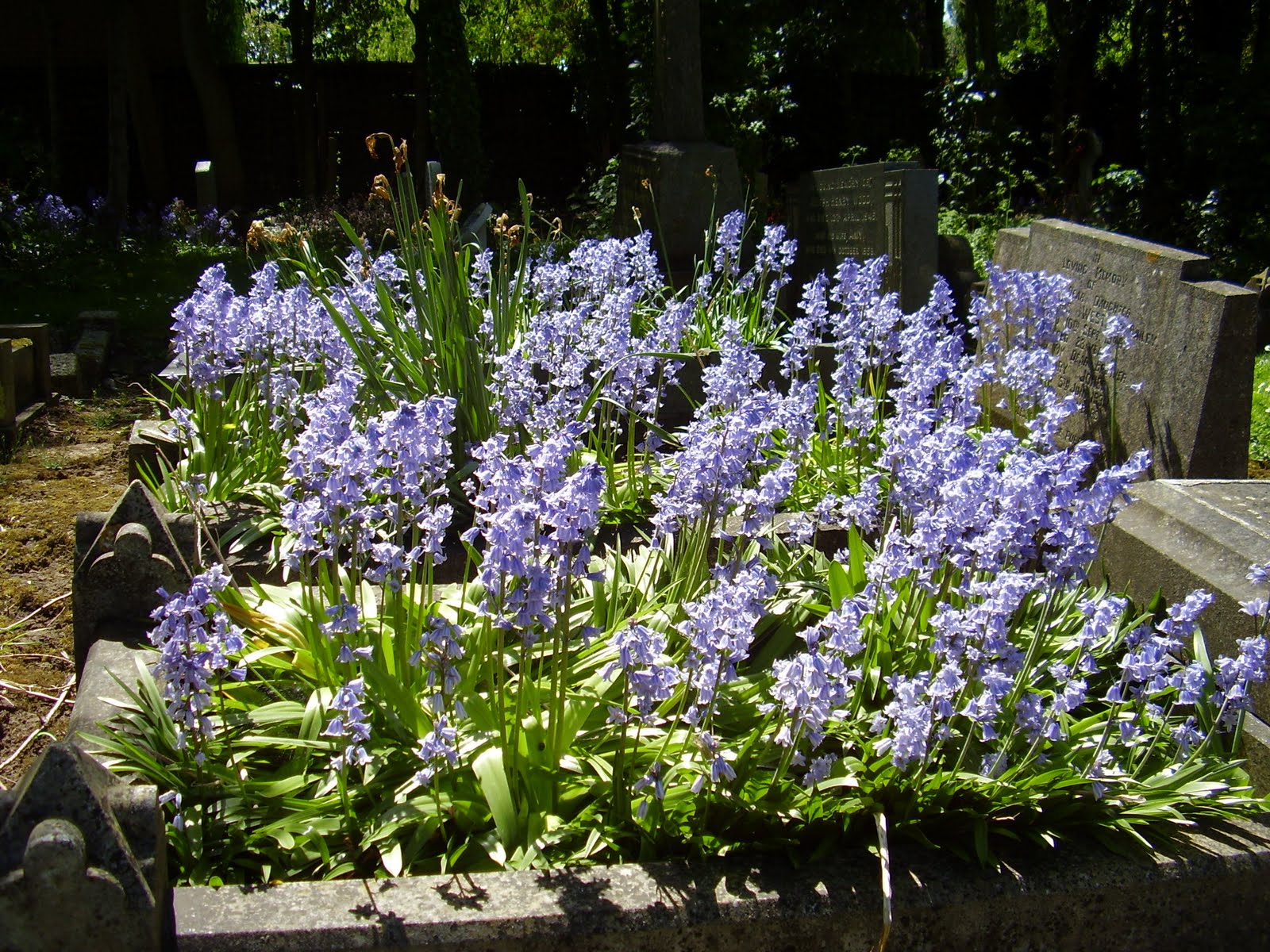
The Spring picture from St Michael's churchyard is now a few weeks out of date.
Subscribe to:
Posts (Atom)