Monday, 7 December 2015

Maps again


I’m back to maps and place names again, itching at the weekend to share with the young people at our monthly alternative evening worship the way they could view the world differently if the map spread out before them was upside down, divided across the Altantic rather than the Pacific, and set out on an ‘equal area’ projection, a world in which we lived tucked away in a remote corner and, instead of us, it is disappearing islands in the middle of the Pacific, once thought of as being at a safe distance from anywhere for nuclear tests, which take centre stage. 

It wasn’t my turn.  I ought to dig out for next month my battered copies of the resource material I developed from copies of Christian Aid’s Peter’s Projection in the 1980s and continued to use with clergy through the 1990s.

In fact I’ve been reading The Cartographer Tries to Map a Way to Zion by Kei Miller, a poet with Jamaican and Rastafarian roots, published last year.  It includes repeated exchanges of points of view between a cartographer and a rastaman, the latter saying On this island things fidget, even history - the landscape does not sit willingly as if behind an easel and Draw me a map of what you see, then I will draw a map of what you never see, and guess me whose map will be bigger than whose? and His work is to make thin and crushable all that is big and real as ourselves. 

There is a circuitous road on Jamacia which still follows the route a Miss Musgrave took on her carriage so that she did not have to view native homes on her way to the Hall - and to think such spite should pass down to the present generation.

Brief quotations don’t carry the impact of the twists and illustrations in my initial two favourite poems which have the cartographer ask How much have we not seen or felt or heard because there is no word for it – at least no word we know? and the rastaman warn My bredda you cannot plot your way to Zion.

It also includes expositions of many Jamacian place names, which sent me back to Brian Friel who died in October.  One of the first academic directions we were given when beginning to study at the Irish School of Ecumenics approaching thirty years ago was: if we wanted to understand the Irish situation a tiny bit better, read Brian Friel. 

Obituaries highlighted above anything else his 1980 play Translations.  I haven’t forgotten the way it has the English ordnance survey in 1833 fixing alien Irish place names with easy to handle English equivalents, the immediate use of which enabled them to direct military operations and oppression efficiently.  Or the one map-making soldier finding the only language he had in common with an Irish girl was a tentatively exchange of Irish place names, which is how we leave them until she artlessly reveals that the process has continued as she tells her mother the names of all the north Norfolk villages around his home.

Meanwhile, this weekend our garden doesn’t know whether it is late autumn (the shrub on the left still has its final leaves to lose) or early spring (the one of the right is already in blossom), and there are other examples of the same confusion along the streets near-by.  The partial job done by our categories, labels and maps is essential to carry our love and our understanding - but it is not enough, and it is dangerous when we think it is where we find our whole truth. 

Tuesday, 1 December 2015

Our War Zone


The Pope has visited the war-torn Central African Republic and the ubiquity of the ludicrous headline ‘The first Pope to enter an active war zone’ (which I’ve found at the BBC, in the religious press and internationally) must, I suppose, mean it was a clever ‘attention grabbing’ line from a Vatican Press Release which has initially been uncritically bought into by most reporters, although a quick search a few days later shows that most have toned this down with something like ‘in living memory’.  

My second thought was that the truth is that, from the barbarians working their way down Italy repeatedly to sack Rome in the fifth century to the Allied troops working their way up Italy to liberate Europe one and a half thousand years later, it is as often the war zone which has come to a Pope as a Pope who has gone to a war zone.  

But my present obvious thought is that he and we all live in a war zone now, not because terrorism continues to brings the consequences of war to European capital cities, but because everything from drones (many ‘driven’, as it happens, from Lincolnshire air bases) to the present on-line lobbying of MPs ahead of their vote on bombing Syria means war no longer happens elsewhere for anybody.

Friday, 27 November 2015

Thy kingdom come


One in five Moslems in this country (or rather, one in five of 1000 particular practicing and non-practicing Moslems responding on the spot to a particular set of loaded questions) agree with the statement “Western liberal society could never be compatible with Islam”.
 
I am as shocked as everyone else in the country by this. 

Why is the percentage so small?  How can 80% of Moslems possibly think that Western liberal society is compatible with Islam?

Are there any Christians out there at all, for that matter, who think that the consumerist, individualistic and exploitative assumptions all around us (however often unconsciously absorbed by us) could ever really be compatible with Christianity? 

Why do we bother praying “thy kingdom come” if any of us think that the Western liberal society is the standard by which we want the will of God for our lives and world to be measured?

Friday, 20 November 2015

Bell story background


I’ve done a bit of fresh work on the names related to the 1833 bell at St George’s, Bradley.

I’m glad because it made me find a 1799 land tax record for the parish which I’m sure I hadn’t seen before.  This record shows, as expected, that Sir John Nelthorpe owned most of the land, although small portions were owner by Mrs Spendlove, --- Heneage Esq and Mrs Scott.  It is their tenants who are taxed, almost all of the tax falling on two of them who must, I assume, have been the largest farmers.  John Nicholson paid £35 and Jas. Phillipson £24 but the five others paid less than £5 between them.

In passing, I notice the Heneage tenant was Nathaniel Kirk (who paid a few shillings).  I assume he was the one whose gravestone (from 1831) was posted here and who has descendants still in farmhouses in the parish today.  I also notice how the surnames largely overlap with those I already knew were the five farmers in the parish in 1841 when the earliest surviving census was taken - then William Phillipson had most land, Samuel Gooseman lived at the Manor, and there was Robert Richardson and both a John Kirk and a Thomas Kirk.

But it is the Nicholson name which stands out in 1799 as the likely father of the man at whose wedding the church bell was damaged.  I suppose it is possible that it was he who lived at the Manor at the time.  There is a gravestone of a Jane Nicholson also from 1831; she was 33 and married to John’s son George, so it might even have been their wedding that the bell was damaged (although I discover George had a number of brothers).

I’ve also easily tracked down the Samuel White of Waltham who recast the bell in 1833 and put his initials on it.  A Waltham man of that name lived 1790-1876.  He is listed as a blacksmith there in a directory entry in 1826.  He is a blacksmith in Kirkgate consistently through the census returns from 1841 to 1871.

Meanwhile, the picture illustrates something quite different, and was taken in St Michael’s on Thursday when the firm which installed the heating system nearly fifteen years ago tracked down to this point and repaired for us the underground leak which had led to system malfunctioning a couple of weeks ago. 

It is the only unpaved bit of the floor; the concrete covers a gap revealed when the 'return stalls' next to the chancel screen were removed ten years ago and was never an aesthetically good idea nor, if it damaged or has put pressure on the pipe, a good idea in any other way.  The repaving of this whole area (where other paved sections of the floor have been damaged by water ingress when the roof leaked) was already on our list of priorities. 

Tuesday, 10 November 2015

The Bells


North East Lincolnshire Council’s archivist has contacted me because he wants to go up our church towers.  

His e-mail gives me more details than I remember having before, and solves a puzzle for me about the initials on the bell at Bradley which I once photographed.

According to 'The Church Bells of Lincolnshire' from 1882, Great Coates should have three bells all recast in 1807 from bells taken from Beelsby by James Harrison of Middle Rasen who also made the bell frame (the book says it is actually a rebuild of an earlier frame as it also carries an inscription to the curate and churchwardens, 1739).

Bradley is best described by the book itself which says: "In 1553 there were here 'iii gret belles and one Sanctus bell.'  The ancient cage for these three bells still remains, but sometime prior to 1833, two bells had disappeared: the remaining bell was cracked by three men endeavouring to imitate a peal upon it with three hammers on the occasion of the wedding of a farmer named Nicholson.  It was then melted down and recast by a blacksmith of Waltham (a neighbouring village) named Samuel White, who placed upon it his own initials, and that of his dwelling place.”

Sunday, 1 November 2015

An earlier Hagia Sophia


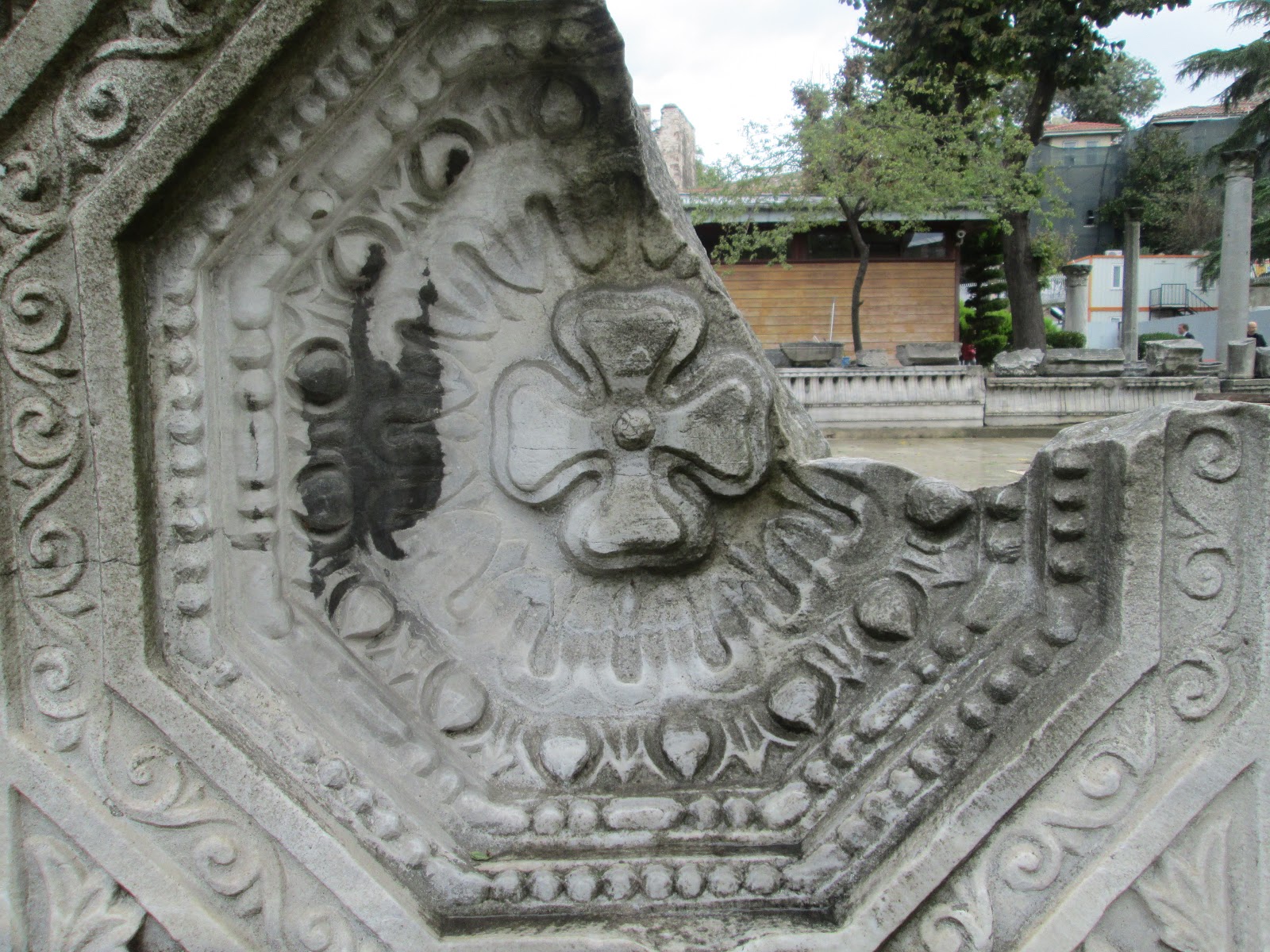
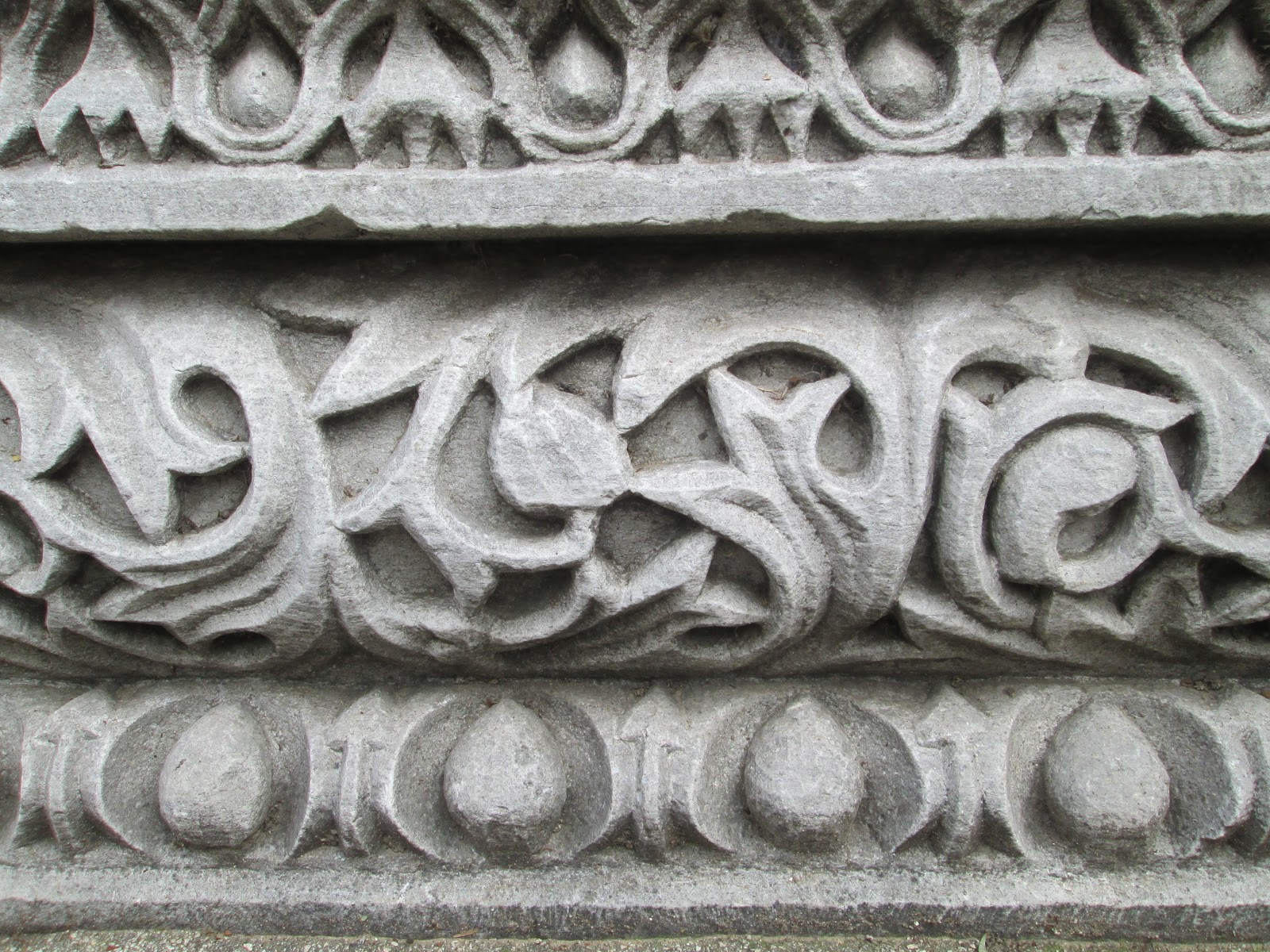
The famous sixth century building actually replaced two earlier churches on the site.  Those bits of its immediate predecessor (which was burnt down by rioters) which have been dug up not that long ago look quite new and sharp having escaped exposure to the weather.  It would have looked much more like a classical temple and one would have walked in beneath a frieze which included the sheep, which represent the apostles.