Showing posts with label St Nicolas'. Show all posts
Monday, 8 July 2013
Great Coates churchyard yesterday
Queen bees dancing together as one hopes to attract the support needed to establish a new colony.
Tips of fresh growth on churchyard yews.
We continue to investigate First World War stories including that of Herbert Lewis who may have been a victim of shell shock; we have now obtained a copy of the certificate of his death at the Lawn, Lincoln (a mental institution) which gives the cause as ‘general paralysis about fifteen months’ seventeen months after his unit was involved in the hideous attack on the Hohenzollern Redoubt in 1915.
And, inside the church, a sailcloth full of unclean beasts ready to be let down from heaven as family worship for Petertide progresses.
Saturday, 29 June 2013
Cutting back complaints
The annual big cut back of Great Coates churchyard took place this week (and we remain grateful to Community Pay Back for its support year after year), not soon enough to prevent the annual complaints about our brief deliberate over growing, and a little too soon to save the last of the meadow flowering from which these pictures come a few days earlier (19th June). Here is a version of an e-mail I sent about the same time as I took the photographs.
I'm sorry you are so upset with the way we manage the churchyard, and I am particularly sorry that you have such unhappy memories of the way we handled the setting for a wedding you attended a while ago. I can only reassure you that we are trying to do something important and creative with our management of the churchyard, and that we now have volunteers who make sure the areas either side of the main path and around the north door are kept neat all the time including when there is a wedding.
We happened to have the Yorkshire Wildlife Trusts' "Living Churchyard" Project Officer visit us last month to assess what we are doing. She was able to highlight the way those who manage churchyards as we do preserves an invaluable habitat for plants and animals. She pointed out to us in particular the way the catapillars of the Red Admiral butterfly are making 'tents' in a nettle patch and the way less common plants such as pink violets flourish, things which are increasingly rare in sprayed hedgerows and intensively farmed fields across the countryside.
The truth is that the churchyard looks fabulous and much admired from the moment the first snowdrops peep through until about the middle of May It is true that we do then deliberately let the churchyard over-grow until this time of year (every year it looks at its worst about now as inevitably tall weed takes over) to allow these plants to set seed properly; if we did not do this we would simply lose the spectacular spring display which is one of the real features and pride of Great Coates.
Over a couple of weekends Community Pay Back then come in and cut it all back for us (although we have no control over exactly when they are available to do this). It is then kept neat by our own volunteers for the rest of the year. I well remember the year that a fire destroyed Community Pay Back's sheds and equipment shortly before it was due to come to us, and the way we were suddenly faced with the almost unmanagable task of doing the annual big cut with no suitable equipment of our own and only a few volunteers - which inevitably then took place much later than it should have done. If you were one of those caught by this, then I can only apologise again for something which was totally outside our control at the time.
We are just developing a small National Lottery bid to help us do things like work on trees (in addition to thousands of pounds worth of essential tree work which we have had to do over the last couple of years) which will include opening up the view of the east end of the church (something the Village Council asked us to consider some time ago) and putting up bird boxes. In this process, we also want to develop small discreet wooden signs and also print a guide to the churchyard so that visitors can really appreciate what is being achieved here and get the most out of visiting.
We are working really hard at things like this. The church itself is one of very few which is normally left open during the day, and we are also just developing material about those commemorated on Great Coates' War Memorials, and about the War Graves in the churchyard in particular. At 7.30 p.m. on 3rd July, we will have Sixth Form students running an evening in church about First World War Poetry which will include a tour of those War Graves. We hope to do more things like this.
I'm sorry you are so upset by the seven weeks (on average) in the year when the churchyard overgrows, and I understand that you would personally prefer a totally different approach to its management, but I hope I have typed enough for it to be clear that the churchyard is neither unloved nor uncared for.
Tuesday, 4 June 2013
First day of the Somme
1st July 1916 through field glasses
When he swept the rise given the nickname
Heligoland, did his mind move rather
to Herr Gätke’s letters to his father
plotting bird migration, building their fame?
Did those boyhood memories focus his sight
on the Humber marsh - where he took cover
once and saw ten thousand golden plover
rise as one so he could not see the light?
Did his mind dwell on the skylarks which sang
full throat as the barrage came to a stop
with the quake of the sap’s cratering bang?
Did he jolt back from home in some surprise
as men began to move in lines, to drop
as they were trained to do… but did not rise?
John Cordeaux (1831-1899), a clergyman’s son, came to Great Coates in his 20s, soon inherited the tenancy of the largest farm from his mother’s uncle (Richard Taylor), and became Agent for Sutton Estates, Churchwarden of St Nicolas’, and the national expert on bird migration. His notebooks include an account of the golden plover flock disturbed in the marsh in December 1879 (‘I could not see daylight through them’). His papers at the Brynmor Jones Library in Hull include over a hundred letters from Heinrich Gätke (1814-1897), pioneer in North Sea migration studies, who was Secretary to the Governor of Heligoland.
Colonel Edward Kyme Cordeaux CBE (1866-1946), John’s son, was born in Great Coates, and baptised by his grandfather in St Nicolas’. He served through the Boer War and was recalled to the army in 1914 to help form the locally raised ‘Grimsby Chums’ battalion of the Lincolnshire Regiment; he was in command when it saw action on the first day of the Battle of the Somme. He married a daughter of Sir Henry Bennett; a sixth generation of Bennetts runs the family timber business from Great Coates Industrial Estate today.
The account of that day in Peter Chapman’s Grimsby’s Own - The Story of the Chums includes nicknames of local features, Cordeaux’s observation through field glasses, the unprecedented but fruitless bombardment of the German trenches until a few minutes before the action, the earth trembling at the force of the mine intended to wipe out those trenches, the skylarks singing, and an officer admiring the precision of the men falling in line before he realised they were in fact being mown down.
The first first-hand accounts in the Grimsby Daily Telegraph, published on 6th July, include the following from three of the wounded in hospital in Southampton. “Never in my life have I seen anything finer than the way successive waves of men marched singing and cheering into the bath of lead. The more casualties they saw in front of them, the louder they cheered and sang, the harder they pressed forward into it.” “What I don’t understand is how the devil they could bring all the machine guns into action after the pounding our heavies gave them.” “I tumbled right on his machine-gun dodge. The trench was knocked flat, but that made no odds. Leading forward from his front line lie lines of tunnel going down into a big dug out over 20 ft deep and splendidly shored up and protected.”
This is all part of the material I've written in preparation for an evening on First World War Poetry in St Nicolas' on 3rd July which will mainly led by pupils from Caistor Grammar School. The picture is of the Gruby family graves in the churchyard, on one of which is commemorated one of the Chums (Reginald Gruby) who never saw the first day of the Somme because he was killed by a sniper four months earlier and who is buried in France.
Monday, 27 May 2013
Listen to the churchyard
There are waves of spring flowers in Great Coates churchyard until each year we let it overgrow to let the seed set. Now dandelion, cow parsley and long grass dominate. The annual complaints will come in until Community Pay Back cut it all back for us.
Listen to the trees. The oldest pines fell in high wind so we spent thousands making them safe and planting new ones. The youngest walnut has cut flowers at its base - they arrived a few hours after the name of a young women whose ashes were scattered there had come round in my prayer diary again. The oldest walnut has new life inside it - bats are roosting there.
Notice what the moat says. Churches do not have moats, but the mediaeval manor house next door did. The ruin was there in 1697 when a traveller mistook it for a dissolved monastery and wrote of its ‘turrits’ and ‘nitches’. A nineteenth century farmhouse was built on the land, and the graves nearest to it are those of the family who farmed there. Listen to the name Riggall – one of those which used to be unique to Lincolnshire (like Blades and Leggett) but now labels new lives across the world.
Catch an echo of local concern about the safety of the railway line. It is provoked by the gravestone of ten year old Willie Adams, son a railway signalman, killed at the level crossing in 1911, and others since. It continues following another tragedy there last month which reigniting prayers in church for those for whom easy talk of new life seems hollow.
Hear the silence of the unmarked graves. We have rediscovered the name of Betsy Moore, an unmarried serving girl. She bought a purgative at the Binbrook May Fair in 1871 to end her concealed pregnancy, but died of the overdose and was buried at night without being allowed a service. She lies near sailors washed up on the Humber bank over the centuries until ‘an unknown male person found dead in the River Humber aged about 40 years’ was buried in 1918. Our remembrance is a prayer for new life for the forgotten.
Let the stone outside the south door speak to you. It is where a long vanished memorial brass was fixed. The church owns two others, and had replicas made ten years ago. After Easter children were making rubbings of the five hundred year old picture on one of them showing Jesus stepping out of his tomb. All hope of new life leads back here.
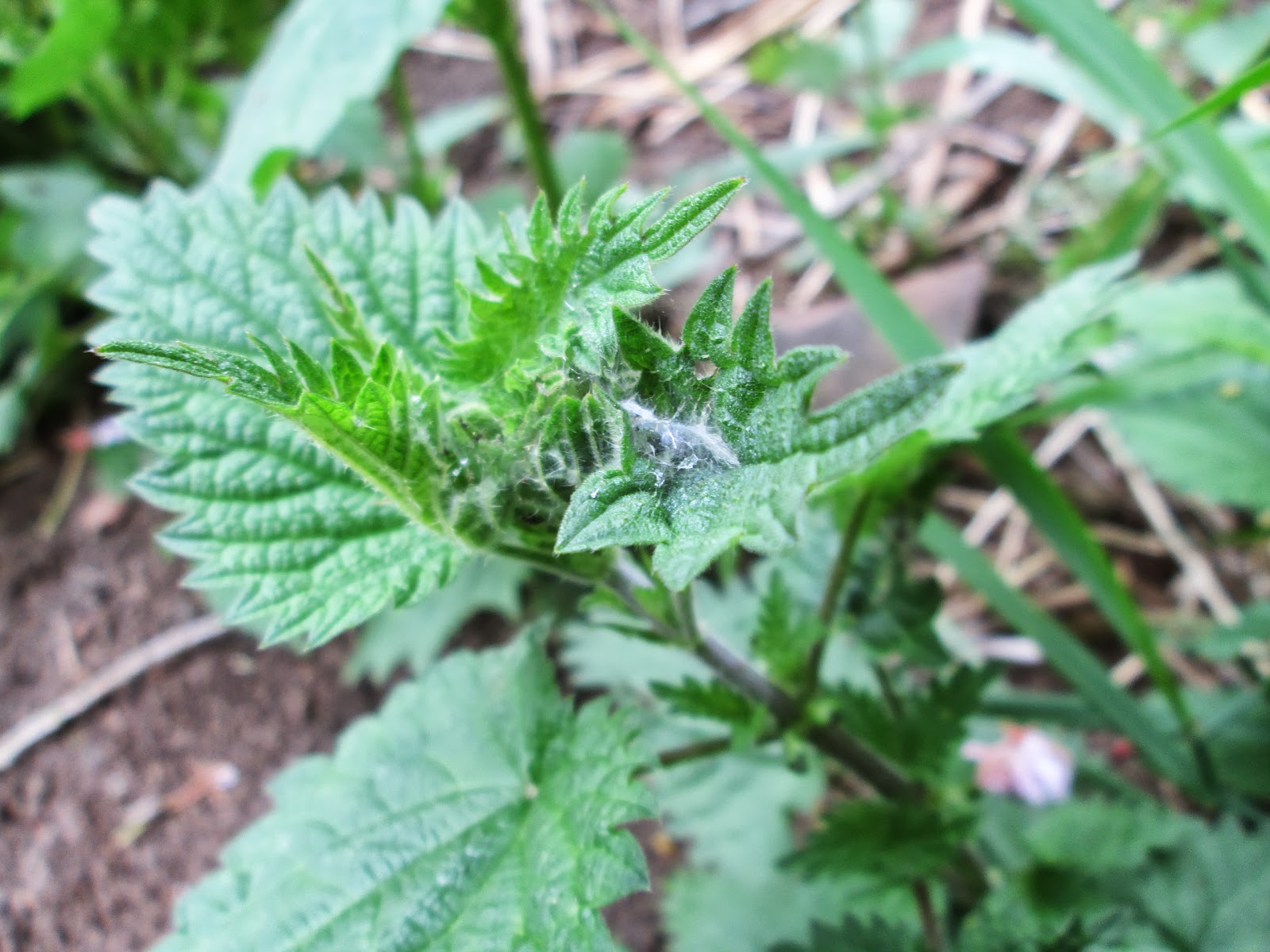
The picture is of nettles in the churchyard last week harbouring what will become a butterfly; a visit from the Yorkshire Wildlife Trust last week highlighted for us the value of the churchyard's nettle patches. The article of mine appeared in the Cleethropes Chronicle last Thursday; some elements of it have appeared in this Blog before.
Listen to the trees. The oldest pines fell in high wind so we spent thousands making them safe and planting new ones. The youngest walnut has cut flowers at its base - they arrived a few hours after the name of a young women whose ashes were scattered there had come round in my prayer diary again. The oldest walnut has new life inside it - bats are roosting there.
Notice what the moat says. Churches do not have moats, but the mediaeval manor house next door did. The ruin was there in 1697 when a traveller mistook it for a dissolved monastery and wrote of its ‘turrits’ and ‘nitches’. A nineteenth century farmhouse was built on the land, and the graves nearest to it are those of the family who farmed there. Listen to the name Riggall – one of those which used to be unique to Lincolnshire (like Blades and Leggett) but now labels new lives across the world.
Catch an echo of local concern about the safety of the railway line. It is provoked by the gravestone of ten year old Willie Adams, son a railway signalman, killed at the level crossing in 1911, and others since. It continues following another tragedy there last month which reigniting prayers in church for those for whom easy talk of new life seems hollow.
Hear the silence of the unmarked graves. We have rediscovered the name of Betsy Moore, an unmarried serving girl. She bought a purgative at the Binbrook May Fair in 1871 to end her concealed pregnancy, but died of the overdose and was buried at night without being allowed a service. She lies near sailors washed up on the Humber bank over the centuries until ‘an unknown male person found dead in the River Humber aged about 40 years’ was buried in 1918. Our remembrance is a prayer for new life for the forgotten.
Let the stone outside the south door speak to you. It is where a long vanished memorial brass was fixed. The church owns two others, and had replicas made ten years ago. After Easter children were making rubbings of the five hundred year old picture on one of them showing Jesus stepping out of his tomb. All hope of new life leads back here.
The picture is of nettles in the churchyard last week harbouring what will become a butterfly; a visit from the Yorkshire Wildlife Trust last week highlighted for us the value of the churchyard's nettle patches. The article of mine appeared in the Cleethropes Chronicle last Thursday; some elements of it have appeared in this Blog before.
Monday, 22 April 2013
Great Coates sorrow
Two men were killed when their car was struck by a train at the Great Coates Level Crossing while we were away on our early Summer Holiday for two weeks after Easter. We found sad headlines about this, and about a separate fatal car accident elsewhere in North East Lincolnshire, on our return. Others have been ministering in different ways – Grimsby Minister opening specially for people to light candles and others have been involved in funerals – and we have set up prayer material in St Nicolas’ which is usually left open during the day anyway.
It was only shortly before going away that I reflected with a few others on the way such deaths are a slowly beating feature of village life. I’d been given a set of Parish Magazines to read for 1896-1925 and came across this just over a hundred years ago
Much sympathy has been shown in the village and neighbourhood with the Adams family in their terrible bereavement, which they have much appreciated, as also the practical form the sympathy took. The funeral was most impressive, and it was touching to see poor little Willie’s fellow choir boys preceding the Rector in the churchyard. This sad death should be a warning to children, and grown-up people too, to be very careful in crossing the line. The wreaths sent were most beautiful.
We had a look at the 1911 census to find that Willie’s father was a railway signalman and the family lived on the north side of the railway line, not far from the home of another ten year old killed on the same spot 67 years later who many local people remember well.
The other sad Great Coates occurrence while we’ve been away, although less devastating, was the removal into storage of the War Memorial from the wall of the former Reading Room (village hall) which is now being developed into a private dwelling. As far as I can find out, this appears to be have been done without any of the necessary planning permission.
The Village Council was already developing a plan to move the Memorial to the grounds of the new village hall being built at the moment, so I very much hope that it will come out of storage in time for Remembrancetide in November and the beginning of the Great War Centenary year a few weeks later, and do so without the time constraint now putting on pressure to settle for less than perfect proposal.
The Memorial lists all who those served in the Great War (not just those who died) and they would have known Willie Adams. By coincidence I had also been reflecting before I went away on Sister Appleyard - the first name on the list, the only female one, and the one most commented upon. Census returns told us that her father also worked on the railway and her family lived almost next door to the Adams. The Parish Magazines furnished me with the following.
We are now sending one of our ‘old girls’ to be a nurse amongst the troops in Egypt. Miss Rose Appleyard. She has been doing good and hard work in the London hospital for some time with civilians and soldiers. We wish her every success in her new post, and pray for her safe return. (June 1917)
Miss Rose Appleyard has arrived safely at Alexandria and is doing work as a nurse amongst soldiers there. We wish her health and strength to carry on her self-denying duties. (November 1917)
We are very glad to see Sister Appleyard back among us once more. She has had a strenuous three years of work as a Nurse in Constantinople and all parts of the East and has had a wonderful experience. She should have retuned home several weeks ago, but has been ‘held up’ at Alexandria for want of a steamer to bring her back. She has been awarded Queen Alexandra’s Imperial Nursing Service Decoration. She is the last of the Great Coates’ War Contingent to be demobilized. She well deserves’s a rest. (September 1920)
Monday, 25 March 2013
Weak enough
God cloth’d himself in vile man’s flesh that so he might be weak enough to suffer woe. This is another quotation from John Donne. I didn’t use it in either of my recent presentations of his work, but I became familiar with it when preparing them, and I take it into Holy Week with me. I particularly like God’s need to be ‘weak enough’. Meanwhile, I took these photographs in St Nicolas’ churchyard this morning.
This one is of Herbert Rollett's gravestone which has fallen, which may not be that surprising after eighty years since it doesn’t look as if it ever had much depth or fixing to anchor itself to the ground. We are trying to develop an Awards for All bid to do work in the churchyard and print a guide to it, and one page of the guide was intended to point to this grave, so (although strictly the gravestone belongs to whoever is his surviving next-of-kin) I wonder whether we could have both it and another much older fallen stone elsewhere safely and securely re-erected next year as part of the same project.
But more interesting than that, the fall reveals the fact that the base of the memorial had been formed by re-use of an earlier gravestone. I wonder whose it was, and how the memorial mason felt he was free to cut it up in this way.
Monday, 28 January 2013
A sad story
Name: Betsy Moore (died fr[om] taking an overdose of Colocynth, taken to produce a miscarriage!). [Colocynth (or Bitter Apple) is a particularly strong purgative which even ancient Egyptians believed was able to provoke miscarriage if taken early in pregnancy.]
Abode: Great Coates (servant at Mr Epworth’s) fr[om] Ludford. [Ludford is a village in the Lincolnshire Wolds thirteen miles from Great Coates.]
Date of burial: 3rd July. [1871.]
Age: 22.
Minister: No ceremony. “Felo-de-se”. By Coroner’s Order! [Felo-de-se is ‘felon on self’ – a now obsolete legal term for someone who takes his or her own life.]
I am writing a piece about the Humber-side nature of the parish and went to the Library to capture some entries from St Nicolas’ burial registers which show how the bodies of unknown sailors washed up on the bank of the estuary were buried in the churchyard. In addition, while I was there, I rediscovered and captured this entry.
Betsy isn’t a diminutive; it (or Betsey) is the form of her given name when it appears in other records.
She was born in the July-September quarter of 1849. She shows up at Ludford aged 2 and 12 in the 1851 and 1861 census returns. In 1851 she was the youngest of four children aged two to six living with her widowed mother. In 1861 she is staying with a charwoman in the village. She doesn’t look as if she had much going for her. ‘Going into service’ within a year or two would have been almost the only option open to her.
In the 1871 census, taken exactly three months before she died, she is indeed recorded as a servant of Mr Epworth at Great Coates. Francis Epworth was a farmer and lived with his wife Sophia, four children and three servants on Aylesby Road. Betsey is listed as a housemaid. (Francis and Sophia’s gravestones are in St Michael’s churchyard.)
The entry in the burial register is in the handwriting of the Revd T B Coopland, the resident Assistant Curate, and, more than anything else, the two exclamation marks say as much about the attitude of the church at the time as the fact the burial went ahead without prayers or a funeral service.
We've uncovered the accounts in both the Lincolnshire Chronicle for 7th July and the Grantham Journal for 8th July.
She had worked at the Epworths for nearly two years and was spoken of as a good servant. She had bought an ounce of Bitter Apple at Binbrook (not far from her Ludford home) on May Day at about the second month of her pregnancy. She took it on 1st July when thought by the cook who gave evidence to be four months pregnant.
Her bowels became inflamed, and she confessed what she had done to the doctor who tried to treat her. She died early on the 3rd, the inquest was heard in the farmhouse later in the day, and she was buried that night. She left no goods or chattels.
Twice recently I’ve come across a Grimsby story in the same year where a housemaid was prosecuted for stealing a single postage stamp, was imprisoned for a day, lost her place, and died from taking rat poison; the story is remembered because of the riot which then took place outside her employer’s house.
A couple of years ago I posted another story from near by Irby-on-Humber seventeen years later which might also have been the result of someone very like Betsy having to conceal a pregnancy.
Abode: Great Coates (servant at Mr Epworth’s) fr[om] Ludford. [Ludford is a village in the Lincolnshire Wolds thirteen miles from Great Coates.]
Date of burial: 3rd July. [1871.]
Age: 22.
Minister: No ceremony. “Felo-de-se”. By Coroner’s Order! [Felo-de-se is ‘felon on self’ – a now obsolete legal term for someone who takes his or her own life.]
I am writing a piece about the Humber-side nature of the parish and went to the Library to capture some entries from St Nicolas’ burial registers which show how the bodies of unknown sailors washed up on the bank of the estuary were buried in the churchyard. In addition, while I was there, I rediscovered and captured this entry.
Betsy isn’t a diminutive; it (or Betsey) is the form of her given name when it appears in other records.
She was born in the July-September quarter of 1849. She shows up at Ludford aged 2 and 12 in the 1851 and 1861 census returns. In 1851 she was the youngest of four children aged two to six living with her widowed mother. In 1861 she is staying with a charwoman in the village. She doesn’t look as if she had much going for her. ‘Going into service’ within a year or two would have been almost the only option open to her.
In the 1871 census, taken exactly three months before she died, she is indeed recorded as a servant of Mr Epworth at Great Coates. Francis Epworth was a farmer and lived with his wife Sophia, four children and three servants on Aylesby Road. Betsey is listed as a housemaid. (Francis and Sophia’s gravestones are in St Michael’s churchyard.)
The entry in the burial register is in the handwriting of the Revd T B Coopland, the resident Assistant Curate, and, more than anything else, the two exclamation marks say as much about the attitude of the church at the time as the fact the burial went ahead without prayers or a funeral service.
We've uncovered the accounts in both the Lincolnshire Chronicle for 7th July and the Grantham Journal for 8th July.
She had worked at the Epworths for nearly two years and was spoken of as a good servant. She had bought an ounce of Bitter Apple at Binbrook (not far from her Ludford home) on May Day at about the second month of her pregnancy. She took it on 1st July when thought by the cook who gave evidence to be four months pregnant.
Her bowels became inflamed, and she confessed what she had done to the doctor who tried to treat her. She died early on the 3rd, the inquest was heard in the farmhouse later in the day, and she was buried that night. She left no goods or chattels.
Twice recently I’ve come across a Grimsby story in the same year where a housemaid was prosecuted for stealing a single postage stamp, was imprisoned for a day, lost her place, and died from taking rat poison; the story is remembered because of the riot which then took place outside her employer’s house.
A couple of years ago I posted another story from near by Irby-on-Humber seventeen years later which might also have been the result of someone very like Betsy having to conceal a pregnancy.
Monday, 14 January 2013
Waiving fees
The legislation which came into effect at the beginning of the month says
the incumbent… may waive any fee payable to the Diocesan Board of Finance (DBF) in a particular case… [and] may, after consulting the churchwardens,… waive any fee payable to the Parochial Church Council (PCC).
The formal explanatory material which accompanied the legislation as it went through the General Synod says
[Fees] may only be waived ‘in a particular case’. That means the incumbent must be able to point to something about the particular case that would justify waiving the fee… DBFs may wish to offer advice to clergy about how and when they wish to exercise their right to waive fees. The [Archbishops’] Council’s advice is that this should only be in cases of clear financial hardship. It is understandable that some clergy have been known to waive fees for those who are long-standing members of the congregation. The [Archbishops’] Council believes, however, that this practice should not be encouraged, certainly as far as the DBF fee is concerned.
So the incumbent has an unfettered right to waive fees. He or she needs nobody’s permission to do so. The Archbishops’ Council offers advice and discouragement, the particular DBF may offer further advice, and the churchwardens must be consulted in relation to the PCC's fee, but none of these other parties may in fact direct the incumbent's decision.
However, the right relates to ‘particular cases’. The incumbent cannot say ‘I don’t believe in the fee system so I will decline to charge fees’. He or she cannot say, for example, ‘the fee for a funeral of someone under 16 is nil, but my general policy is not to charge a fee for a funeral of any teenager’ or ‘my general policy is not to charge those who over time have given substantial financial support to the church’.
What he or she can say is ‘this particular person is in real financial difficulties so I will not charge’, and also, I assume, he or she can say things like ‘I judge it would be a pastoral disaster to charge a fee in this particular case so I will not do so’.
The Lincoln DBF has issued its booklet of advice. This says, under the heading ‘Key changes’,
Fees cannot be waived generally, only in particular cases and only be the incumbent who must be able to point to justifiable reasons, such as hardship, and should consult the Archdeacon.
This is almost fine so far, although perhaps ‘should consult the Archdeacon’ is already a bit of a stretch from the DBF advising or requesting that the Archdeacon be consulted; since the legislation names consultation which must take place (with churchwardens in relation to the PCC fee) it follows that nobody can actually require additional consultation.
But three pages later the Lincoln DBF advice has a substantive paragraph under the heading ‘Waivers’ which reads in full:
PCCs cannot waive any portion of the DBF fee without permission from the relevant Archdeacon. The PCC fee or any other local fees may be waived by the PCC or incumbent, as agreed between the PCC and incumbent.
It is difficult to believe that either of these sentences has been written or approved for publication by anyone who has engaged properly with the legislation, let alone by anyone who wishes to be taken seriously exercising a formal right to offer advice in relation to it.
The first sentence names the PCC and Archdeacon as the two parties involved in a decision about waiving the DBF fee. But we have seen that neither of them is actually a party to that decision (other perhaps than being parties which the DBF might or might not advise the incumbent to consult).
The second sentence names the PCC and incumbent as the two parties who must agree any decision about waiving the PCC fee. But we have seen that it is the incumbent who decides, after consulting the churchwardens, and the PCC isn’t involved (still less a party which needs to agree).
There are also further obvious problems with naming the PCC as a party to any of this. We have seen that the waiving of fees can only be considered in particular cases not as matters of general policy, so it is very difficult to see what role a PCC might actually play. A PCC will only meet a few times in a year and so simply wouldn’t be in a position to advise let alone agree about a particular case (especially where a quick decision about a funeral fee needs to be made). And anyway it would be totally inappropriate to share any information about the financial situation of individual parishioners with such a body.
It may seem perverse, but I’m actually a little relieved to find this level of incompetence demonstrated so clearly in the booklet. It shows just how far the Working Party who dealt with this matter on behalf of the DBF has gone off piste. The serious but in most cases futile objections I have raised about the rest of what the DBF is imposing on us suddenly looks less like the rantings of one of the diocese’s difficult clergymen.
As I look at other diocesan websites, I see that most (but sadly not all) advice about waiving fees is accurate and reasonable, and no other one makes things up about a PCC role. I also see that the universal new practice elsewhere in the Church of England is that parishes continue to collect all fees and then disburse them as necessary – payments of the DBF’s fee to the DBF being monthly (in some cases quarterly) and accompanied by a single page form listing the relevant services and fees. I hate to think how much paid time is to be spent in our Diocesan Office administering every individual funeral payment across the whole of old Lincolnshire, or how much extra clergy and volunteer time is to be spent completing a separate form relating to every separate individual fee generating activity.
The photographs were taken after Matins at St Nicolas’ this morning.
Monday, 7 January 2013
Red tower / big drill
When I arrived for Matins one day last week, I discovered that the angle and quality of the dawn sun was briefly doing this to St Nicolas' tower.
Meanwhile work was also beginning to enhance flood protection for the houses immediately north of St Michael's, and the little boy in me enjoyed the drill best.
Monday, 3 December 2012
Building in fields
There is a large and detailed mid-eighteenth century map showing the boundaries and names of all the fields in the single estate which was the parish of Little Coates. It is held in the North East Lincolnshire Council Archive behind Grimsby Town Hall. I’ve had a photocopy of it across several A3 sheets for some time. Recently I’ve tried to copy it across on to a contemporary map, and the picture above is an extract.
Although some fields had been divided and other united, the rural parish was substantially the same nearly two hundred years later in the 1920s when the estate was auctioned in separate lots. So it is not a surprise to see the way modern housing fits into the old field pattern. For example, at the south-western corner of the map, the present Laceby Acres estate occupies exactly the land which was High Field, Mill Close and Old Close.
Some of what I’ve drawn isn’t quite right, but there were an impressive number of places where careful measuring of where to draw a line took me to exactly the place where whole lines of properties back on to each other. For example, just east of St Michael’s, the way the parts of Church Meadows accessed from Laburnum Drive and the parts accessed from Cherry Tree Crescent back on to each other shows very neatly the old boundary between Chapel Field and Home Close.
The power of many old parish boundaries fascinates me. They may date back to patterns of land ownership in the Dark Ages formalised into larger territories as soon as any centralised forms of early English government arranged obligations or taxation by area. This is strikingly visible on this map. Little Coates became part of the Borough of Grimsby in the 1920s, Great Coates in 1970s, and building then took right up to but not across these ancient parish boundaries, so that suddenly they became visible to the naked eye. For example, travelling from Aylesby along Aylesby Road one can look across fields to the edge of Laceby Acres (which follows the ancient Little Coates – Laceby boundary) and the edge of Wybers Wood (which follows the ancient Great Coates – Aylesby boundary).
But the story is not yet over. Consultation is underway to create a new Local Plan for North East Lincolnshire. We are told that we need to build 9000 new homes in the next twenty years or so. Land owners have been asked to identify where they think these might be built, and something like 16000 sites have been offered. Planners now need to know which of these to include in the new Local Plan. Since so much recent building has been on the eastern side of Grimsby (from Scartho Top to New Waltham), and since access to the A180 and potential areas of employment growth are on the western side, there may be some presumption that much new building will be planned on the western edge of the built up area.
So I saw the map last week which shows potential development a field or so further west. Offers of sites exist for some 2868 houses. A new Aylesby Park could be built north-west of the present Aylesby Park across Aylesby Road. A new Wybers Wood could be built south-west of the present Wybers Wood. A new Laceby Acres could be built west of the present Laceby Acres north and west of Morrisons.
If any of this started to become real and immanent possibilities then we would need to have conversations with our neighbouring ecclesiastical parishes because the new Wybers Wood development would actually be in the present ecclesiastical parish of Aylesby, although the houses would all be much nearer St Nicolas’, Great Coates than the tiny village of Aylesby. And the new Laceby Acres development would be in the present ecclesiastical parish of Laceby; in the case, although separated from it by fields, the new houses would be as close to the larger village of Laceby as to St Michael’s, Little Coates.
Although some fields had been divided and other united, the rural parish was substantially the same nearly two hundred years later in the 1920s when the estate was auctioned in separate lots. So it is not a surprise to see the way modern housing fits into the old field pattern. For example, at the south-western corner of the map, the present Laceby Acres estate occupies exactly the land which was High Field, Mill Close and Old Close.
Some of what I’ve drawn isn’t quite right, but there were an impressive number of places where careful measuring of where to draw a line took me to exactly the place where whole lines of properties back on to each other. For example, just east of St Michael’s, the way the parts of Church Meadows accessed from Laburnum Drive and the parts accessed from Cherry Tree Crescent back on to each other shows very neatly the old boundary between Chapel Field and Home Close.
The power of many old parish boundaries fascinates me. They may date back to patterns of land ownership in the Dark Ages formalised into larger territories as soon as any centralised forms of early English government arranged obligations or taxation by area. This is strikingly visible on this map. Little Coates became part of the Borough of Grimsby in the 1920s, Great Coates in 1970s, and building then took right up to but not across these ancient parish boundaries, so that suddenly they became visible to the naked eye. For example, travelling from Aylesby along Aylesby Road one can look across fields to the edge of Laceby Acres (which follows the ancient Little Coates – Laceby boundary) and the edge of Wybers Wood (which follows the ancient Great Coates – Aylesby boundary).
But the story is not yet over. Consultation is underway to create a new Local Plan for North East Lincolnshire. We are told that we need to build 9000 new homes in the next twenty years or so. Land owners have been asked to identify where they think these might be built, and something like 16000 sites have been offered. Planners now need to know which of these to include in the new Local Plan. Since so much recent building has been on the eastern side of Grimsby (from Scartho Top to New Waltham), and since access to the A180 and potential areas of employment growth are on the western side, there may be some presumption that much new building will be planned on the western edge of the built up area.
So I saw the map last week which shows potential development a field or so further west. Offers of sites exist for some 2868 houses. A new Aylesby Park could be built north-west of the present Aylesby Park across Aylesby Road. A new Wybers Wood could be built south-west of the present Wybers Wood. A new Laceby Acres could be built west of the present Laceby Acres north and west of Morrisons.
If any of this started to become real and immanent possibilities then we would need to have conversations with our neighbouring ecclesiastical parishes because the new Wybers Wood development would actually be in the present ecclesiastical parish of Aylesby, although the houses would all be much nearer St Nicolas’, Great Coates than the tiny village of Aylesby. And the new Laceby Acres development would be in the present ecclesiastical parish of Laceby; in the case, although separated from it by fields, the new houses would be as close to the larger village of Laceby as to St Michael’s, Little Coates.
Monday, 9 July 2012
Building worries
It may be the tower of St Nicolas’ which is moving (or, more specifically, slowly sinking towards the south) rather than the south aisle which is moving away from the body of the church. That is the slightly disturbing conclusion of the measurements taken today based on the fixed points established not quite five months ago, although nobody is suggesting that the massive and majestic tower is about to topple over.
Today’s measurements actually show that the crack between the aisle and the tower has closed a bit, which wasn’t what we had expected at all. It is not this measurement but instead a simple horizontal pencil line drawn across the crack five months ago which shows where there has been vertical movement; the picture shows this looking at the west wall, with the aisle on the left and the tower on the right of the crack.
Given that a Churchwarden at St George’s rang this morning to say that some lead flashings have been taken from the building there, it hasn’t been an encouraging day regarding the stewardship of our buildings.
Monday, 2 July 2012
Serendipitous links
Japanese researchers have found unusually high levels of carbon-14 in cedar tree rings laid down in 775. A report in New Scientist in June speculated whether a solar flare (rather bigger than ones otherwise evidenced) might have been responsible, or, perhaps more plausibly, a series of flares over a couple of years.
On a whim, I took down an edition of the Anglo-Saxon Chronicle and was delighted to see that it’s almanac-like set of a couple of facts for every year has for 773 or 774 the information that ‘a red cross was seen in the sky after sunset’ (and ‘strange adders were observed in Sussex’), although the dating is difficult as the 776 Mercian-Kentish battle at Otford is recorded in the same sentence.
However long the shot, I was sufficiently taken by the vague possibility that I had stumbled across an interdisciplinary insight that I sent New Scientist a letter about it which, to my surprise, it published last week.
Meanwhile, I’m developing some single illuminated sheets for our three churches each with one slightly more secure bit of historical information. I have just placed one about the Taylor memorial in St Nicolas’ (including the picture of the grave of Richard Taylor Esq posted here last week) and another about the Tickler memorial window in St George’s (including its references to the family’s Grimsby based jam manufacturing).
The two picture above are a first attempt (I need to go back soon and get something better) to capture what I need to illustrate an information sheet about the coat of arms of the Barnardiston family - which owned Great Coates between the 1300s and the 1600s and members of which are commemorated in the pre-Reformation brasses in St Nicolas’.
The top picture includes the Barnardiston coat of arms among fragments of mediaeval glass set high in a plain window in St Nicolas’ (which I guess was placed there as part of a re-fenestration at the time of the restoration in the 1860s). The bottom picture is of the entrance to Great Coates Primary School. I wonder at what stage the school adopted this as its logo (which appears on pupils' sweat shirts as well as the door)? And whether those who adopted it thought it was the Great Coates coat of arms or whether they knew full well that they were borrowing a design from a particular family of former Lords of the Manor?
Anyway, putting the two pictures together provides another serendipitous link which I hope some people will enjoy - certainly those at the school who gave me permission to photograph its front door did not know the design comes from the Barnardistons (and they tell me that the school is considering creating a new logo soon anyway, so the link may soon disappear).
Monday, 25 June 2012
Richard Taylor Esq
How common is it to put ‘Esq’ after someone’s name on their gravestone? I can’t remember coming across it before, but it can’t be unheard of elsewhere. I’ve walked passed this grave often (it is on the path along the south side of St Nicolas’, Great Coates) but it was only last week that I noticed the ‘Esq’, and it was only then that I made the link between the grave and the Richard Taylor commemorated on a memorial tablet in the church (about which I posted a while ago). The fact that they bothered putting this honorific on his gravestone is further evidence that, in the absence of any resident gentry, this farmer was regarded as a leading citizen in the village.
Monday, 23 April 2012
Inside St Nicolas' again
I have just found this postcard view of the interior of St Nicolas’, Great Coates at about the time of the First World War. It is much clearer than the slightly earlier image which I posted with commentary on 8th July 2008 (http://www.petermullins.blogspot.co.uk/2008/07/inside-st-nicolas-great-coates.html). The shape of the east window, the nature of the hangings along the east wall and the details of the false chancel arch (none of which survive today) are things I haven’t seen before.
The picture must have been taken after the work authorised by the 1900 Faculty (because the present pews are in place) but before the work authorised by the 1925 Faculty (because the present wooden backing to the altar is not yet in place), and it is interesting that the lectern (in a new position but with the same decoration on it as in the earlier picture) has not yet been replaced by the present brass First World War memorial lectern.
I can now see that I was wrong to suggest that the present semi-circular step in front of the altar was part of the work undertaken in the 1920s. The metal altar rails in this picture clearly curve (it is easiest to see this on the left / north side), and, now that I look at this again, I see there are repair marks in the stone evident today to show where this altar rail was once fixed. I would now suggest that it is may have been part of the 1865 restoration; the pulpit and the artificial chancel arch may well date from 1865 as well.
It is the chancel arch, of course, which is most striking. As far as I can see from the small amount of this arch which shows up in the earlier photograph, it appears to have been painted since the earlier photograph was taken.
The picture must have been taken after the work authorised by the 1900 Faculty (because the present pews are in place) but before the work authorised by the 1925 Faculty (because the present wooden backing to the altar is not yet in place), and it is interesting that the lectern (in a new position but with the same decoration on it as in the earlier picture) has not yet been replaced by the present brass First World War memorial lectern.
I can now see that I was wrong to suggest that the present semi-circular step in front of the altar was part of the work undertaken in the 1920s. The metal altar rails in this picture clearly curve (it is easiest to see this on the left / north side), and, now that I look at this again, I see there are repair marks in the stone evident today to show where this altar rail was once fixed. I would now suggest that it is may have been part of the 1865 restoration; the pulpit and the artificial chancel arch may well date from 1865 as well.
It is the chancel arch, of course, which is most striking. As far as I can see from the small amount of this arch which shows up in the earlier photograph, it appears to have been painted since the earlier photograph was taken.
Monday, 9 April 2012
Less water, more trees
A hose pipe ban has began, and the reason why is clear from this pair of pictures of Kingston Wood by the water tower on the edge of the parish. The top picture was put up on this Blog on 19th March 2010 when there was concern that the rising water table was damaging the area. The bottom picture was taken last week, just over two years later.
Meanwhile, a contributor to Rod Collins' website has found this old postcard image of St Nicolas' (and of the Grange next door). This is clearly number 3 in a series of which the image of a monument in St Michael's churchyard put up on this Blog on 13th March 2010 was number 5 (so I'd dearly love to be able to find numbers 1, 2 and 4, and possibly numbers 6 onwards). The bottom picture is the 'same view' yesterday.
Monday, 26 March 2012
Fresh eyes
We announced yesterday that the Revd David McCormick is coming in May to work with us as Team Vicar and with St Andrew’s Hospice as Chaplain. David was brought up in Grimsby and returned to be Team Vicar of St Hugh’s in our neighbouring Great Grimsby Team Ministry before moving ten years ago to work full-time in the diocese’s training team, so we are looking forward to welcoming him back.
In my twelve years or so here we haven’t worked with an external work consultant in this Team Ministry (at one point the Bishop offered to try to identify one for me, but nothing came of that, and it is a serious fault of mine that I haven’t ever pursued this), so it will be particularly interesting and valuable for me and us this summer and autumn to engage with what he will be observing about and reacting to my and our established approaches.
Meanwhile, last week the newish Priest-in-Charge of the Great Grimsby Team has very kindly sent his neighbours the terms of reference for the review of that Team parish, including a quite thorough assessment of the role of the Minster there and of his role as Area Dean both serving the whole of North East Lincolnshire including this Team parish. He won’t know that nine months earlier the Deputy Chief Executive of the diocese wrote to me on behalf of himself and the Archdeacon to say there would be consultation with the Deanery Pastoral Committee about these terms of reference, but even at the time we didn’t imagine that was actually going to happen.
So there will be fresh eyes in both neighbouring Team Ministries, and much opportunity to engage constructively rather than defensively with what they see.
The other over view of at least part of this parish at the weekend was provided by going up the towers of St Michael’s (which I do quite often) and of St Nicolas’ (which I have only done once before). There is a report and ten much better pictures at http://www.rodcollins.com/wordpress/inside-a-church-tower-and-the-view-from-the-top. The top picture here picks out a spiral of flowers on the north side of St Michael’s which wasn’t there last year. The bottom picture of two ships passing on the Humber hints at how unexpectedly close Yorkshire is to St Nicolas’.
Labels:
Grimsby Minster,
Ministry,
St Michael's,
St Nicolas'
Monday, 27 February 2012
Village websites
Bradley village has a new website established by the Parish Council. It is at http://www.bradleyvillage.co.uk/ and quite apart from anything else, opens with a beautiful photo of St George’s. It has put up historic information based mainly on the material I put together for it and posted here a short while ago. It has also put up some news from the church for February for which I am grateful. It did put up information about activities at Bradley pitches on the edge of the village, but has now taken this down again, I guess because members of the Parish Council are very unhappy about the way this facility has been allowed to develop and be used and therefore don’t want to give it publicity. I’ve tried at various times to encourage those in the village who take different sides in this dispute to be generous in relating to those with whom they disagree so sharply, but I’m not sure such intervention has been welcome, and it is sad that this dispute has also led to different people leaving the Parish Council at different stages. Personally I shall also be sad if the new website doesn’t become home to open information about all activities in or on the edge of the village whether originating from church, Parish Council, pitches or anywhere else, but I will have to be sensitive with those who don’t agree with me about that.
There is another Parish Council at the other end of our ecclesiatical parish, and the Great Coates Village Council also has a well established website at http://www.greatcoatespc.com/ (through which information about St Nicolas’ can be accessed by clicking on the electronic version of the village newsletter). Sadly, exactly the same pattern of internal disputes, and excatly the same pattern of some members leaving the Village Council, is going on here; the issue is whether or not the Council should take a substantial loan to build a new Village Hall. I haven’t been able to engage here because I’d look like an interested party since the proposal does spike the guns a bit of our ambition to develop St Nicolas’ to meet some of the relevant needs. The opening page of the website has a link to the results of a formal Parish Poll in which 40% of the registered voters turned out to vote 87 to 377 against the proposal; there is what could be misunderstood as a disingenuous reference to the turn out at the last parliamentary election (63%) rather than local authority election (33% in the relevant Ward).
I took the photo this morning in Great Coates churchyard. The crosses mark the graves of Canon Quirk (further away) and Canon Barber (nearer) who between them were Rectors of Great Coates between 1892 and 1954. Quirk’s immediate predecessors were non-resident, and Barber’s immediate successors were also incumbents of Aylesby, so their sixty-two years was a brief high point in the ideal of committed long-term residence in a single small community. They were both highly respected and probably much better than me at judging how to help villagers relate to each other well, although last week I did visit a parishioner who is more than a hundred years old who recalled Mrs Quirk’s negative reaction to being refused a little girl’s curtsey at some point in the 1920s.
Monday, 16 January 2012
St Nicolas' South Aisle
Meanwhile his attempt to dig down to foundation level to see if there is anything going on there failed when it hit this concrete apron round the building (a twentieth century drainage channel - we can't work out why it continues underground here). He’d like to get a digger in to do more investigation if his monitoring does show continued recent movement. In these circumstances he would also like to investigate inside where the south aisle roof beams meet the main body of the church to make sure they haven’t been pulled out so far that they might cease to provide support. Our hope is that neither of these further investigations will prove necessary.
Tuesday, 29 November 2011
Remembrance wreathes
We are all finding Remembrance better attended and better observed. At one time observations had shifted exclusively to the Sunday, and it might have been assumed that even this would fade as those with direct memories of the two World Wars died off. Now silence is being observed mid-week again, and things such as the repatriation of those killed in places such as Afghanistan is persistent in our consciousnesses.
At Great Coates we had a service at the village War Memorial for the first time in a number of years. I’d asked about this when I arrived twelve years ago and was told that those involved in the British Legion and in other ways joined in the larger commemorations in the centre of Grimsby so there was no call for a service in the village. Twelve years on and a particular request for this observation comes in, St Nicolas’ shifts its service an hour earlier to make way, and we find local radio wanting to do an interview, quite a number extra people attending what became the 9.30 a.m. service, and perhaps as many as a hundred people of all ages at the War Memorial at 11.00 a.m.
This week the wreathes laid then were moved from the private land by the War Memorial into the churchyard. The position was chosen because it is close to a number of graves associated with the World Wars - one of two standard Commonwealth War Grave Commission stones, commemorating Ernest Reeve who died as a result of the Second World War, can be seen at the back centre of the picture. The large memorial at the front is also a First World War war grave and I’ve just discovered (prompted by Rod Collins website) that the Herbert Lewis buried there died in the Lawn mental institution in Lincoln which makes me wonder whether he was a victim of shell shock.
I’d actually put together some basic information about all those named on the War Memorial or buried in the churchyard. The village magazine reproduced this and an updated copy of it is left out in church. I am gradually amending this as fresh information, such as that about Herbert Lewis, comes in.
At Great Coates we had a service at the village War Memorial for the first time in a number of years. I’d asked about this when I arrived twelve years ago and was told that those involved in the British Legion and in other ways joined in the larger commemorations in the centre of Grimsby so there was no call for a service in the village. Twelve years on and a particular request for this observation comes in, St Nicolas’ shifts its service an hour earlier to make way, and we find local radio wanting to do an interview, quite a number extra people attending what became the 9.30 a.m. service, and perhaps as many as a hundred people of all ages at the War Memorial at 11.00 a.m.
This week the wreathes laid then were moved from the private land by the War Memorial into the churchyard. The position was chosen because it is close to a number of graves associated with the World Wars - one of two standard Commonwealth War Grave Commission stones, commemorating Ernest Reeve who died as a result of the Second World War, can be seen at the back centre of the picture. The large memorial at the front is also a First World War war grave and I’ve just discovered (prompted by Rod Collins website) that the Herbert Lewis buried there died in the Lawn mental institution in Lincoln which makes me wonder whether he was a victim of shell shock.
I’d actually put together some basic information about all those named on the War Memorial or buried in the churchyard. The village magazine reproduced this and an updated copy of it is left out in church. I am gradually amending this as fresh information, such as that about Herbert Lewis, comes in.
Thursday, 24 November 2011
St Nicolas' steps
Tree surgeons have been in St Nicolas’ churchyard for the last three days and have finally tidied up branches and whole trees in which dead wood had gradually accumulated or which had become dangerous last winter or which threatened to interfere with neighbours roofs. With this, and with the support of two volunteers (one long standing from Great Coates village, and one recruited this year through a local volunteering scheme), we have also been able to put the churchyard to bed for the winter in a safer and tidier manner than we might have hoped.
But, with two steps forward, there are also two steps backwards. The diocese has drained down the water in the empty Vicarage next door as required by its insurer to prevent burst pipes this winter suddenly depriving the church of the use a loo and an external tap. And the crack in the south aisle wall which we thought we’d put right earlier in the year has opened up again so we have had to get the Archdeacon’s permission to engage a structural engineer to make a more substantial investigation. Neither is that important in itself, but these sorts of things add to the slight sense the church has that the odds stack up against it.
Subscribe to:
Posts (Atom)