Monday, 9 September 2013
Sunday, 8 September 2013
Still looking east
I’ve spent most of this year with images of a religious
geography telling truths our usual physical geography does not tell (Jerusalem is
at the centre of the world), and with the idea that facing east towards Jerusalem (as
Christian churches, worshippers and graves do, akin to Moslem facing Mecca)
being our fundamental desired ‘orient-ation’
(which is simply literally ‘east-facing’ anyway). From where I usually stand, facing Jerusalem
(as well, as it happens, as facing Mecca) is to face the rising sun, and I am
now reminded that the mediaeval name for the land at the far end of the Mediterranean
is the Levant, and discover this is the French for dawn.
Now I am here, which way do I look? Is it a bit like the puzzle of knowing which
way is south for the one standing at the North Pole? No, it seems that I have allowed the sense of
‘facing Jerusalem’ to be too dominant.
The Institute’s Director (an Orthodox priest) has twice reminded us that
we should still be looking east from here, looking longingly in the direction
from which we expect to find the Second Coming.
He added that ‘without this hope, this place would crush you’: here at the centre of the world its conflicts
and impossibilities are focussed and not resolved; the dawn is not in the Levant.
Meanwhile, on this out first Sunday, we attended Mass in French in St Anne’s Church very close to the Temple site, thus praying on the feast of the
Birth of the Virgin Mary at the traditional site of that birth (and hard by the
certain site of the Pool of Bethsaida).
Saturday, 7 September 2013
Friday, 6 September 2013
Thursday, 5 September 2013
Opening challenge
"For such a small place as this country, it is very complex (and everyone is totally lacking in objectivity); if you don't go away more confused than when you arrived, we will not have done our job." This was the Course Director's opening gambit during supper on our arrival, and the picture is from the terrace of the room in which we eat, looking across the separation wall to Bethlehem.
Sunday, 18 August 2013
Hebrew context
The pace of
this Blog now changes. I haven’t posted
for two weeks, and in two weeks time we go away for thirteen weeks Extended
Study Leave (nee Sabbatical) at the Tantur Institute on the edge of
Jerusalem.
Some of my
time at the moment is spent arranging things with those who will be living in
the house and those who will be looking after the parish, rather than posting
here .
I suspect
that I’ll then want to use the Blog as a way of saving pictures and ideas for
myself, but the Institute warns participants in its courses about missing the
sabbatical experience by spending a disproportionate amount of time updating
others on social media, so what I post will be unsystematic, and possibly
episodic.
With the
background reading we’ve been asked to do, I’ve already begun to reinhabit the
Hebrew culture of much of the Gospels.
Last Sunday,
I explored new ideas for me as I found part of the Gospel (Luke 12.37-38)
identified by Kenneth E Bailey as Hebrew
poetry, with the first and last lines in parallel, then the second and
penultimate ones, then the third and antepenultimate ones, pointing to the
‘conclusion’ at the centre.
Blessed are
the slaves
when the
Lord coming he finds them watching:
amen I tell
you he will gird himself
and he will make them recline
and coming
he will serve them;
whichever
watch coming he finds it so
blessed are
they.
We feel we
can almost touch the Galilean preacher who habitually identifies the blessed,
says ‘amen’, speaks of the God’s Kingdom as a wedding banquet, and turns the
idea of servanthood upside down, all features which colour lots of other parts
of the Gospel.
Today, I
explore old ideas with one of the two set Old Testament readings (the beginning
of Isaiah 5) where these fourteen lines
Let me sing
for my beloved
my
love-song concerning his vineyard:
My beloved had a vineyard
on a very fertile hill.
He dug it and cleared it of stones,
and planted it with choice vines;
he built a watch-tower in the midst of it,
and hewed out a wine vat in it;
My beloved had a vineyard
on a very fertile hill.
He dug it and cleared it of stones,
and planted it with choice vines;
he built a watch-tower in the midst of it,
and hewed out a wine vat in it;
he expected
it to yield grapes,
but it yielded wild grapes.
And now,
inhabitants of Jerusalem
and people of Judah,
judge between me
and my vineyard.
and people of Judah,
judge between me
and my vineyard.
are clearly in the minds of the first speaker and hearers
of these Gospel lines (placed by Matthew soon tells us Jesus’ cursed and unproductive fig
tree)
There was a
landowner
who planted a vineyard,
put a fence
around it,
dug a wine
press in it,
and built a
watch-tower.
Then he
leased it to tenants
and went to another country.
When the
harvest time had come,
he sent his
slaves to the tenants
to collect
his produce.
But the
tenants seized his slaves…
Now when the
owner of the vineyard comes,
what will he
do to those tenants?’.
Meanwhile,
bees and butterflies swarm round plants in our garden in a way at which this
picture only hints.
Monday, 5 August 2013
Another break-in?
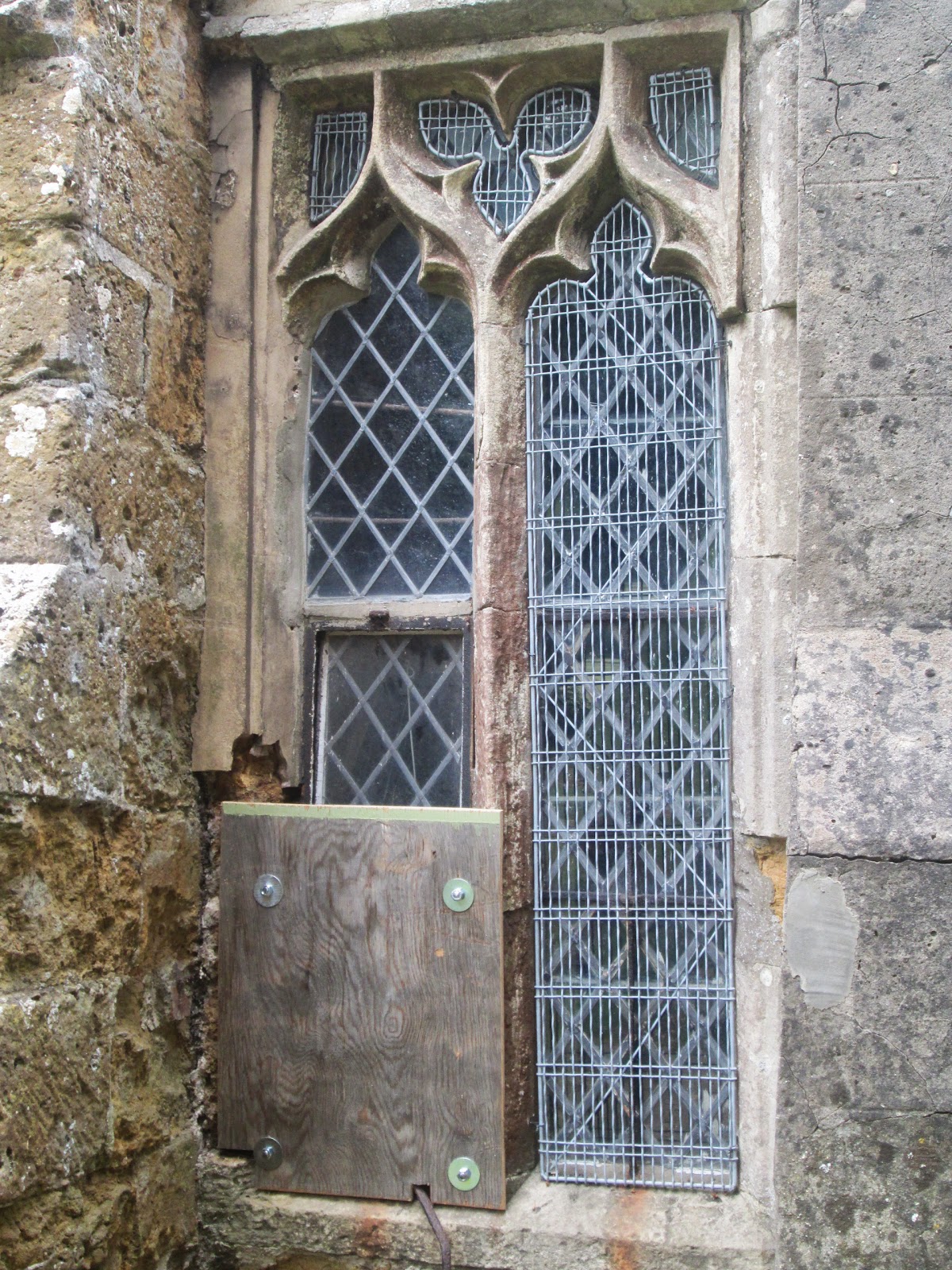
A temporary repair to the south window in the chancel at St George's, Bradley where it appears a burglar removed both the mesh and a whole window panel to gain entry; this would be third occasion in my time here that a window has been damaged in this church in this way, and, when the facts and details are established, it is possible that once again the cost of the repair will be far higher than any costs involved in losses from the apparent break in itself. Meanwhile, some of the the villagers have contributed during July for the first time to a church-based collection of tinned food for the Daily Bread Community Larder in Grimsby, so, as it happens, the church had been doing its part in seeking to support those in greatest need locally at the same time.
Subscribe to:
Posts (Atom)